Updated August 2026 · every entry's Google Play released date falls inside August 2026, read the day this page was built
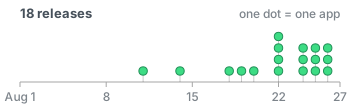
Verified against the Play Store listings on 27 August 2026 · full breakdown below. Eighteen listings carried an August released field; seventeen are reviewed here and one is named in the exclusions instead, with the reason printed beside it.
This page lists new Android apps, and it defines new the only way that can be checked: an app appears here if and only if the "Released on" field on its US Google Play listing reads August 2026. Nothing else counts. Not the date a press release went out, not the day an embargo lifted, not a relaunch, a rebrand, a big update, or the month an app happened to reach a journalist's phone. The store record is the source; where the record and the coverage disagree, the record wins.
That rule exists because it was checked. During sourcing, every launch-month claim taken from press coverage failed against the Play record. Apps celebrated as new this August turned out to carry field dates from July, from June, from February, and in one case from 2016 under an annually refreshed name. Some of the most-promoted "new" apps of the month publish no released field at all, which means the claim cannot be verified, which means it does not qualify. The named exclusions section further down lists the biggest of these, each with the date its own listing publishes.
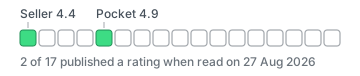
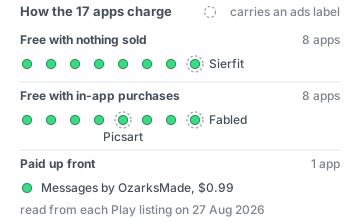
Held to that bar, August 2026 produced 18 qualifying apps. Two of them have a published rating. The other sixteen are so new that Google has nothing to say about them yet: no rating, and install counters reading between 0+ and 100+ where the stars would go. That is what a genuinely new cohort looks like, and it changes what a review can honestly say. Nobody knows how these apps behave after a month of real use, because they have not existed for a month. So each review here argues from the record as it stood on the read date printed at the top of the review: what the listing promises in its own words, what it costs, whether it carries an ads label, what the Data Safety section declares, what the developer has shipped before, and what the listing conspicuously does not say. Each review ends with the one question a month of real users will settle.
Read it in that spirit. These are verified releases, not verdicts. The verdicts arrive in September, and the field date will still be the rule when they do.
Messages by OzarksMade is our best overall because its listing, read 3 September 2026, sells it once at $0.99, no ads label, SMS, MMS and RCS in one app.
Pile is our best free pick because its listing, read 3 September 2026, shows it free with no ads label and nothing sold, and the same build is published on F-Droid.
Redock is our niche pick because its listing, read 3 September 2026, shows a free SSH and Mosh terminal with no ads label and unlocks from $5.99.
Data checked: 3 September 2026.

SMS, paid once
The best new messaging app of August 2026 is Messages by OzarksMade, the one new release this month that charges a dollar up front instead of carrying ads, and the first visible attempt to give former Samsung Messages users their app back. For the best established messaging apps, see the messaging roundup.
100+ · $0.99, paid once · released on Play Aug 19, 2026 · by OzarksMade™ · Contains ads: No · checked 27 August 2026
Google Play listing · read 27 August 2026
Messages by OzarksMade is an SMS, MMS and RCS app from OzarksMade, a small developer whose Play account has been shipping since late 2024. It costs 99 cents, once. There is no subscription, no ads label and no in-app purchase range on the listing. That alone makes it a strange sight in a category where free is the norm and the costs sit somewhere less visible.
The reason it exists is not hidden. Samsung retired its own Messages app this year and moved Galaxy owners to Google Messages, and some of them did not want to go. This app is built for exactly those people. Its listing, read Aug 27, opens with "Messaging that feels like home" and promises rounded conversation cards, "green bubbles for texts and blue for chats." The What's new note says the app "is designed primarily for Samsung Galaxy devices." The description ends with a legal paragraph naming Samsung twice: "not affiliated with, authorized by, endorsed by, or connected to Samsung Electronics Co., Ltd. or Google LLC." Nobody writes that paragraph unless they expect people to arrive looking for Samsung.
The design is two apps in one, and the listing is precise about it. In Standalone Mode you "make Messages by OzarksMade your default messaging app and send texts and multimedia messages straight from your phone." In Companion Mode you "link with Google Messages and keep chat features like typing indicators, read receipts, reactions and end-to-end encrypted conversations, while Messages by OzarksMade gives you the interface." Switching modes, it says, "takes a tap." The feature list is long and unusually concrete: reactions with any emoji, scheduled messages, dual SIM support, a two-pane layout on foldables, per-conversation backgrounds, a trash that keeps deleted messages for 30 days, and app data backup and restore after a reinstall.
Read that mode split carefully, though. The chat features people actually mean when they say RCS, the typing indicators and the end-to-end encrypted conversations, are listed under Companion Mode, where Google Messages does the transport. The Standalone paragraph promises texts and multimedia messages. Whether Standalone Mode carries RCS chats by itself is not spelled out anywhere on the page, and the listing's own caveat applies: "Some features depend on your carrier, your device, and the person you are messaging."
This is a week-old app. The Play record reads released Aug 19, 2026 and updated Aug 20, 2026, and the What's new note is candid about how young it is: "Welcome to the first Production release of Messages by OzarksMade! Thanks to our Closed Beta testers, the app has significantly improved over the past three weeks." The install band is 100+ and no rating is published. In plain terms: a few hundred people at most have paid the dollar, and not enough of them have rated it for Play to print a number. That is not a warning sign. It is what week one looks like for a paid app with no marketing budget. It does mean nobody can tell you yet whether it is reliable day to day.
The real catch sits further down the same listing page. The Data safety section, read the same day, declares "this app may share these data types with third parties" and names "Personal info, Messages and 5 others." It then states "no data collected," "data isn't encrypted" and "data can't be deleted." Taken literally, that describes an app which shares your messages with third parties while collecting nothing, which is not a coherent combination. These forms are filled in by the developer and Play prints them as given; new developers get them wrong in both directions, and a first production release two weeks out of closed beta botching the form is the likeliest explanation. But the likeliest explanation is not a fact. What the listing commits to today, in writing, is sharing of personal info and messages, no encryption and no deletion. For an app whose whole pitch is a quiet, respectful home for your texts, that section is the loudest thing on the page, and anyone considering the purchase should read it before paying. The developer links a privacy policy on its own domain; the declaration is what Play shows shoppers.
Who is this for? Galaxy owners who kept Samsung Messages until the end, want the old layout back, and are comfortable paying a dollar to try a version 1 from a small shop. Companion Mode is the low-commitment path, since Google Messages keeps doing the transport underneath. Who should skip it: anyone on a non-Samsung phone expecting a native fit, and anyone for whom the Data safety declaration, as written, is disqualifying. Both are reasonable positions this week. For what the established messaging apps actually collect, the 2026 messaging deep dive reads Signal and SimpleX line by line, and there is a separate roundup of free SMS apps for privacy-conscious users.
The open question: whether a month of production users and the developer's next pass at that Data safety form leave this looking like the Samsung Messages heir, or just the first app to have claimed the empty seat.
Meta's gizmo feed
Meta shipped two unannounced apps in August, and the more immediately useful one is Seller, a Facebook app, which gives Marketplace sellers a dedicated workbench for listings, buyer messages and repricing. For the best established shopping and lifestyle apps, see the shopping and lifestyle hub.
10K+ · Free · released on Play Aug 20, 2026 · by Meta Platforms, Inc. · Contains ads: No · checked 27 August 2026
Google Play listing · 4.9 · read 27 August 2026
Pocket is a Meta Platforms app that appeared on Play on Aug 20 with no launch event attached. It is not the read-it-later service of the same name, which Mozilla retired; this Pocket's package id is com.facebook.gizmo, and the gizmo is the point. Its listing, read Aug 27, defines the term itself: "A gizmo is a small interactive experience you can tap and touch... and you can make a gizmo just by describing it."
The listing is organized around three verbs. Explore: "Scroll a feed of gizmos from people around the world. Gizmos respond to your touch and the tilt of your phone." Create: "Make a gizmo just by describing it. Open the editor to tweak and refine it until it's exactly what you want." Curate: save the gizmos you like and browse "playlists made by people like you." Gizmos can play sound effects, "use your camera or pull in photos from your camera roll," and, in the listing's most loaded sentence, "Some can even reason about the world around them."
That sentence is as close as the page gets to saying how any of this works. The description never uses the words AI, model or prompt. "Describing it" is the entire technical disclosure. Anyone who has followed this year's consumer AI launches will recognize what is underneath, a text-to-app generator with a social feed on top, and the Aug 20 date on the Play record matches the day the app opened to US users at large. But the listing itself commits to none of that vocabulary. Meta has chosen to sell this as a toy box, not as an AI product, and that choice tells you who it is for.
The numbers a week in: 10,000+ installs, a 4.9-star rating as of Aug 27 on a review count still in the hundreds, rated Teen, filed under Art & Design. Two things about that. First, outside Meta's own pair, every app in this month's cohort measures its installs in tens or hundreds; Pocket reached five figures in its first week, which is what Meta's distribution machinery does on its own, and proves nothing about the app. Second, a 4.9 in week one belongs to the early adopters who went looking for it. It says the people who wanted this like it. It does not yet say anything about everyone else.
The price structure, as of Aug 27: free to install, no Contains ads label, no in-app purchase range published. Generating "a small interactive experience" from a text description costs compute every time someone presses create, and today's listing shows no mechanism paying for it: no ads declared, no purchases, no subscription. Free and unmetered is a launch posture, not a business model, and the listing makes no promise in either direction about where this settles.
The Data safety section is published and reads the standard Meta way: the app may share personal info with third parties, may collect "Location, Personal info and 7 others," data is encrypted in transit, and deletion can be requested. None of that is surprising from this developer, and the camera and photo access it declares is in the feature list itself. What the listing does not say: what happens to the gizmos you make and the photos you feed them, whether any of it trains anything, whether a gizmo can leave the app in any form, or when the doors open outside the US. None of those absences is an accusation. They are the questions the page leaves open, and with an app this new there is no user record to fill them in.
Who should try it: anyone curious about what prompt-to-app tooling looks like when a company with Meta's resources aims it at casual creators, and anyone who enjoys feed-shaped novelty in its first month, before the imitations arrive. Who should skip it: anyone who wants stated terms about ownership and data use before investing hours in making things, and anyone who does not need another Meta feed in their life. For established picks that are games rather than machines for making them, see the games roundup.
The open question: whether the Explore feed a month from now holds gizmos people come back to, or whether this follows the arc of every prompt-to-content system so far, a busy first weekend and a long quiet after.
Marketplace workbench
5K+ · Free · released on Play Aug 11, 2026 · by Meta Platforms, Inc. · Contains ads: No · checked 27 August 2026
Google Play listing · 4.4 · read 27 August 2026
Seller, a Facebook app, is the name exactly as Play prints it, comma included. It is the second unannounced Meta release of the month and the more explicable one: Facebook Marketplace selling, split out into its own app. The package id, com.facebook.wallaby.pulse, is pure internal codename, and nothing about the launch was dressed for an audience; the app simply turned up on Play and started iterating. Its listing, read Aug 27, states the job plainly. It is "a dedicated selling app for Facebook Marketplace," where you "manage your listings, message your buyers, and track your performance."
The description reads like a small-business tool because that is what it is. A home dashboard surfaces "items to ship, buyers to respond to, listings to reprice." Bulk operations get their own paragraph: "Reprice, relist, or delete in bulk. Create multiple listings at once." Messaging is separated from your private life: "Buyer conversations live here, separate from personal chats." And the sync commitment, the load-bearing sentence for anyone who already sells, is explicit: "Listings you create or edit in the Seller app automatically appear on Facebook Marketplace for buyers to find and purchase."
Unlike Pocket above, this listing names its AI. "Upload photos and Meta AI fills in the details," and the details it lists are "title, description, price, category." Price is on that list. An app offering to set the asking price on your goods from a photograph deserves one specific habit: read what it wrote before you publish. The listing also promises "pricing recommendations and relisting suggestions based on what's actually selling," which is the kind of aggregate-data feature only the platform operator can build, and the honest argument for a first-party seller app over the Marketplace tab it grew out of.
The record here is the cleanest of any app in this month's cohort. Released Aug 11, 2026. Updated Aug 21, 2026, version 3.0.0.2.215, minimum Android 8.0. An update ten days after release, carrying a version string that deep, is what an actively staffed product looks like; most of this month's cohort has shipped exactly once. The install band is 5,000+ and the rating stands at 4.5 stars as of Aug 27, on fewer than a hundred reviews. That is enough signal to say it works for most of the people who grabbed it early and annoys some of them, and not nearly enough to say anything finer.
Price and ads, as of Aug 27: free, no Contains ads label, no in-app purchases published. The app costs nothing because it is plumbing for a marketplace Meta already operates; whatever fees apply to selling are a Marketplace matter, and this listing prints no numbers about them. Data safety is published in full: "No data shared with third parties," may collect "Location, Personal info and 6 others," data encrypted in transit, deletion can be requested. Note the situation without overreading it: in one month of releases, the Facebook company's app carries one of the cleaner declarations while a one-dollar texting app elsewhere on this page carries the most troubling one. Both are developer-filled forms. That is exactly why they are worth reading rather than assuming.
What the listing does not say. It does not say whether selling inside the main Facebook app changes, or whether features will migrate here over time and leave the tab behind. It does not distinguish the casual seller from a business account, or say who this is sized for beyond "your listings." It requires a Facebook account by construction, "Sign in with your Facebook account," so there is no version of using it at arm's length from Meta. And it says nothing about availability beyond the US listing surface it was read from.
Who should try it: anyone who sells on Marketplace more than occasionally, has felt listings, buyer chats and repricing scatter across a personal Facebook app, and wants them in one place; the separate buyer-message inbox alone can justify the install for a regular seller. Who should skip it: people who list one sofa a year, for whom the Marketplace tab is fine, and anyone unwilling to give a second Meta app residence on their phone for a workflow gain.
The open question: whether Meta treats this as a product with a roadmap or as an experiment, since a spun-out companion app only keeps its place on a seller's phone while the updates keep coming.
Stencil photo prints
In photo and video, August 2026 belongs to tone - photos, printed, a stencil-print photo tool from Japanese developer Yojihan that sells one look, deeply done, for a single $3.19 unlock instead of a subscription, and the only new photo app this month whose listing never says the word AI. For the best established video editor apps, see the best video editor apps for Android; for the best established photo editor apps, see the best photo editor apps for Android.
0+ · Free · one in-app purchase, $3.19 · released on Play Aug 22, 2026 · by Yojihan · Contains ads: No · checked 27 August 2026
Google Play listing · read 27 August 2026
The full store name is "tone - photos, printed", lowercase t, and it comes from Yojihan, a Japanese indie developer. Play files it under Art & Design rather than Photography, and that filing is the honest one: this is not an editor, it is a renderer with a single aesthetic. It turns photographs into stencil-print artwork, the overlapping-ink look of risograph posters and zine pages. Released on Play Aug 22, 2026; as of Aug 27 it shows 0+ installs and no published rating, so nobody outside the developer's circle has publicly weighed in yet.
The description, as it stood on Aug 27: "tone is a photo app that gives your pictures the character of stencil printing." And then, plainly: "Pick a photo, and fine halftone dots and overlapping inks turn it into something like a two-color poster or zine page." Two modes split the audience. Simple mode is for playing: "tap the random buttons to explore combinations of colors, halftones, and frames," with a guided tour from loading an image to exporting it. Customize mode is for people who know what a screen angle is: the listing promises per-color control over "dot frequency, screen angle, density, and print behavior," two screening methods (halftone dots and grain), one-to-three-color overprint, and five paper stocks "including white, natural, gray, and kraft." Margins, corner radius and hand-cut edges are editable; there are step-by-step views of "separation, screening, and overprint"; tablets get a side-by-side layout; the app ships in Japanese, English, Korean and Chinese.
Read that vocabulary again. Screen angle, separation, overprint, per-color density: these are print-shop terms, not filter-app terms. Whoever wrote this description has stood next to a riso machine. And one word never appears in it: AI. In an August cohort where nearly every creative listing leads with generation, this one describes dots, inks and paper, and stops there. That restraint is the most distinctive thing about the app and the reason it heads this section.
The money is equally plain. Free to install, no ads badge, and exactly one in-app purchase listed, $3.19, as of Aug 27. The listing states precisely what it buys: "7 extra inks, custom preset saving, and 2x/3x high-resolution artwork export are unlocked with the one-time purchase 'Ink Set 02'." One-time. No subscription, no credit meter, no tiers, no trial that converts. In the 2026 creative-app economy that pricing shape is close to extinct, and it makes the app's worst case a known quantity: you are out at most the price of a coffee.
The Data Safety section, read from the listing on Aug 27, declares no data shared with third parties and no data collected. That declaration is consistent with the rest of the page, which says your last source image and settings "are saved on device and restored automatically." Nothing here needs a server, and the developer declares none. Data Safety entries are self-reported, so this is coherence rather than proof, but it is the cleanest possible declaration and most photo apps cannot make it.
What the listing does not say. The name reads like a printing service; it is not one. Nothing on the page offers physical prints; export means "Save finished artwork to your photo library," and the paper stocks are simulated. The base export resolution is never quantified: 2x and 3x export sit behind the unlock, which implies a 1x default the listing never states in pixels. There is no mention of RAW input, batch processing, or direct sharing to anything. And this page establishes no track record for Yojihan; whether the developer has shipped and maintained apps before cannot be judged from the listing alone.
Who should try it: anyone who makes zines, gig posters, or club flyers; anyone who liked the riso look on a screenprinted record sleeve and wants it from a phone photo; tablet owners who want the preview and controls side by side. Who should skip it: anyone who wants correction, retouching, portraits or a hundred looks in one app, because this is one look, deeply done. For established filter apps with track records and ratings, see the best photo filter apps for Android.
How the renderer behaves on ordinary material cannot be known yet. Riso-style reduction flatters bold, well-lit, graphic subjects; a dim restaurant snapshot is a different problem, and no user has published results either way. The open question: whether everyday phone photos, shot in everyday light, survive the two-color reduction well enough that people who buy Ink Set 02 are still opening the app in October.
Big-name video editor
0+ · Free · in-app purchases $12.99 to $199.99 per item · released on Play Aug 24, 2026 · by PicsArt, Inc. · Contains ads: Yes · checked 27 August 2026
Google Play listing · read 27 August 2026
Picsart Video Editor & Maker is the biggest name in this month's photo and video cohort and the most guarded listing in it. PicsArt, Inc., the company behind one of the most installed photo editors on Play, published this separate video package on Aug 24, 2026. Three days later it sits at 0+ installs with no published rating, which is what a three-day-old package looks like and tells you nothing. What tells you something is what the listing says, and what it very deliberately does not.
Start with what it says. The first line, read Aug 27: "Turn photos and ideas into AI-generated videos, cinematic edits & AI-scored soundtracks." The pitch is generation first, editing second: you "generate video clips from text or photos, edit and restyle any scene with AI, and score it with AI-composed music." The feature list runs through talking AI avatars, lip-synced narration, background swaps, object removal, trending templates, and exports sized for TikTok, Reels and YouTube Shorts. The intended user is defined by three short sentences: "No filming skills. No editing experience. No music production knowledge." So this is not a timeline editor with AI bolted on. It is an AI generation service with editing attached, filed under Video Players & Editors and rated Teen.
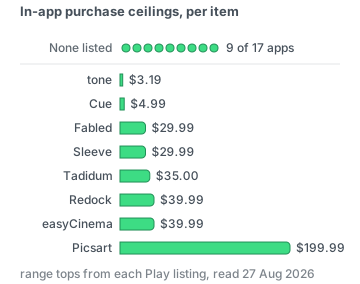
Now the money, because the listing is more specific about the ceiling than the floor. The app is free to install, carries a Contains ads badge, and lists in-app purchases from $12.99 to $199.99 per item as of Aug 27. The mechanism sits in the description's last paragraph: "Use credits to generate, edit, and score videos with AI. Need more? Subscribe to receive a fresh bundle of credits each month and keep creating." Metered credits, refilled by subscription, with a published single-purchase ceiling of $199.99. What a credit buys, how many arrive free, what any tier contains, whether free exports carry a watermark: none of it is on the page. Every practical question about the cost of actually using the app is unanswered. The only two numbers Picsart publishes are the cheapest purchase and the most expensive one.
Then there is the omission that existing Picsart users should read twice. The description never mentions the main Picsart app. Not once. Nothing about whether a current Picsart subscription carries over, whether the video tools now living here will stay in the photo app, or whether the two apps share an account. The only trace of the mothership anywhere on the page is Play's own related-apps rail, which Picsart does not control. A company splitting a product in two usually says what moves and what stays. This listing says nothing, and until it does, anyone already paying Picsart should assume nothing.
The Data Safety section, read from the listing on Aug 27, is filled in and worth reading. The developer declares the app may share personal info, photos and videos, and five other data types with third parties, and may collect personal info, financial info, and six more. That is roughly what cloud AI generation requires, and Picsart declares it plainly rather than hiding it. It is also the exact opposite of the on-device, nothing-collected declarations the two smaller apps in this section make. Your photos leave the phone and your clips are rendered on someone else's machines; the label says so in as many words.
Who should try it: creators who already pay for AI video generation somewhere and want it on a phone, people who feed TikTok or Reels on a schedule, and anyone curious what "advanced AI video models" means in practice this month, since the listing never names which models those are. Who should skip it: anyone expecting a conventional cut-and-trim editor, because the description spends one bullet on that and dozens on generation; anyone allergic to credit meters, because the pricing shape is a meter by the listing's own account; and existing Picsart subscribers who assume their plan covers this app, because no sentence on the page promises that.
What cannot be known yet is almost everything that matters. There is no rating, and under house rules there would be nothing to cite if there were one this young. There are no visible user reports of generation quality, render times, watermarking, or how aggressive the ads are on the free tier. Picsart's track record on Play says the company can run a large free app for years; it says nothing about how this credit economy will be tuned. The open question: what the first month of real users finds the free tier actually produces before the meter stops it, because the listing prices the ceiling at $199.99 and describes the floor not at all.
Object eraser
10+ · Free · released on Play Aug 22, 2026 · by NS BUSINESS SOLUTIONS · Contains ads: No · checked 27 August 2026
Google Play listing · read 27 August 2026
CleanSnap AI Object Eraser does what its name says: you brush over a person, a power line or a trash can, and the app removes it and rebuilds the background. It ships from NS BUSINESS SOLUTIONS, a company name that tells you nothing, with no developer website linked on the listing and a privacy policy hosted on a free Google Sites page. Released on Play Aug 22, 2026; as of Aug 27 it shows 10+ installs and no published rating. Object erasers are the single most crowded corner of the Photography category, and most of the crowd runs on the same recipe: upload your photo to a server, watch an ad or start a trial, subscribe to keep the results. This app earned a section because of one sentence in its listing that breaks that recipe.
Here is the sentence, read Aug 27: "100% On-Device Processing: Your photos stay on your phone. No internet connection required for the AI to work, ensuring complete privacy." Everything else in the description is standard for the genre. Its listing calls the app "your ultimate photo editing tool," promises you can "magically remove unwanted elements in seconds," offers a blemish remover for selfies, brush and lasso selection, and says edited photos save "without losing original resolution or quality." The register is marketing and the claims are ordinary. The on-device line is the only claim that separates this listing from fifty others, and it is a claim a reader can actually check against the rest of the page.
So check it. The Data Safety section, read from the listing on Aug 27, declares "No data shared with third parties" and "No data collected." That is what an on-device tool should be able to declare, and most competitors cannot: a cloud eraser has to declare uploads because the photos genuinely leave the phone. Two caveats belong next to this. Data Safety entries are written by the developer, so a matching declaration is coherence, not proof. And coherence from a developer with no track record is worth less than coherence from one with years of listings behind it. Still, the declaration is on record, it is the cleanest one available in this niche, and Google holds developers to what they file there.
The money is the strangest part. Free to install, no ads label, and no in-app purchases listed at all as of Aug 27. That means the listing shows no visible business model: nothing to watch, nothing to subscribe to, nothing to unlock. There are two ways to read that. The generous reading is a portfolio piece or a genuine free tool. The realistic reading is that the paid layer has not arrived yet, because in this niche free apps that get traction usually grow ads or a pro tier by update. Either future would show up on this same listing page first, in the ads badge or the in-app purchase line, both empty today and both dated in the fact line above.
What the listing does not say. Nothing about the size of the on-device model or what it does to storage; nothing about which phones can run it comfortably, and on-device inference is exactly where older hardware struggles; nothing about limits, watermarks, or a maximum resolution for the AI pass, since the no-quality-loss line covers the export, not the reconstruction; no example of a failure case, and every eraser has failure cases, usually fences, hair and repeating patterns; and nothing about who NS BUSINESS SOLUTIONS is or what else it has shipped. The content rating is Everyone. That is the entire public record of this developer as far as this page can establish.
Who should try it: privacy-conscious users who occasionally need to remove a photobomber and refuse to upload family photos to a server for the privilege; travelers editing offline; anyone who wants to test whether the on-device claim survives airplane mode, which is the cheapest verification this app allows. The cost of trying is zero by every number on the listing. Who should skip it: anyone cleaning up photos that matter today, because not one person outside the developer has publicly vouched for the output quality; and anyone who needs an actual editor around the eraser, with curves, crops and color. For the best established photo editor apps, see the best photo editor apps for Android.
A month from now this listing will look different in one of two directions: either real installs and first impressions accumulate around a genuinely free on-device tool, or the monetization arrives and the fact line above stops being true. The open question: whether the on-device results stand next to the cloud incumbents once strangers start publishing before-and-after verdicts, because as of Aug 27 not a single one exists.
Serialized audio
Sleeve is the entertainment and audio pick for August 2026, and it earns that on a one-sentence listing that commits to exactly the things a listener can check for themselves: local library, internet radio and podcasts in one offline-first player, gapless, lossless, no ads label, and a Data Safety section that declares no data collected. For the best established music apps, see the music player roundup; for movies and TV, see the movie streaming roundup and the TV streaming roundup.
0+ · Free · in-app purchases $0.99 to $29.99 per item · released on Play Aug 26, 2026 · by PocketFM · Contains ads: Yes · checked 27 August 2026
Google Play listing · read 27 August 2026
Fabled is the second consumer app from the company behind Pocket FM, and the only launch in this section backed by a publisher with a measurable Play history. The developer field on the new listing reads exactly "PocketFM", one word. The same account's main app, Pocket FM: Audio Series, showed a 4.4 rating, a rating count in the millions and a 100M+ install band when its listing was read on 27 August 2026. Fabled itself has none of that yet: released Aug 26, 2026, a 0+ install band, no published rating. One day of history, carried entirely by the parent's.
The strange part is the description. Read 27 August 2026, it opens with "Discover Pocket FM, the world's #1 audio series platform" and never once says the word Fabled. Pocket FM is named eleven times. The genres on offer are listed as romance, horror, thriller, drama, and "Fantasy & Sci-fi". Every figure in the text belongs to the parent platform: "more than 100,000 hours of content", "500,000+ creators", audio fiction "loved by 200M+ listeners worldwide", listeners who "spend an average of over 110 minutes daily on the platform", even a "fun-loving and active community of listeners" that, on this listing's own 0+ install band, cannot yet exist here. The changelog under What's new reads "Brand new design for users." on an app that was one day old when read. Nothing on the page says what Fabled is for, how its catalog differs from Pocket FM's, or why the same company now runs two storefronts for what its own text describes as one platform.
What the text commits to, it commits to as Pocket FM features rather than Fabled ones, but the commitments are at least concrete. "Our offline listening feature lets you download episodes and listen without an internet connection." There is an "in-built sleep timer", adjustable playback speed, and a closing line that promises the catalog on "your Mobile, Desktop, Chromecast, TV or Wear OS". Even the small print keeps pointing at the parent: the description's own footer links a privacy policy at pocketfm.in while the Play record's privacy field points at pocketfm.com, and the follow links lead to Pocket FM's own Instagram and Twitter accounts, the Instagram one an India-branded handle. Two domains, one company, zero mentions of the app being described.
The money model, to the listing's credit, is stated plainly. Episodes are metered: "You get free episodes of your favorite audio series everyday", and the text defends the metering in its own words: "No lock-in period. You only pay when you exceed the free episode limit." Paid bingers are promised a "Zero waiting period for new episodes". The Play record adds the numbers the prose leaves out: a Contains ads label, in-app purchases from $0.99 to $29.99 per item, and an In-app purchases flag beside the Contains ads label under the title. The listing also offers to "Eliminate ads with 'No-ads' pack", which confirms the free path carries ads until they are paid off. So the free tier is both rationed and ad-funded, single purchases run to $29.99, and what one episode costs inside that spread is not published.
The Data Safety section, read from the listing the same day, says the app may share personal info, app activity and two other data types with third parties, and may collect personal info, app activity, and device or other IDs. Data is encrypted in transit and deletion can be requested. That is the developer's own declaration, which Play notes may be updated over time, and it is the broadest third-party sharing declaration in this section.
Who should try it: listeners already comfortable with serialized audio fiction and per-episode unlocks, who want the romance, horror, thriller and drama serials the listing leads with, delivered by a publisher that demonstrably operates at scale. Who should skip it: anyone expecting an audiobook app rather than an episodic serial machine, and anyone who wants to know the total cost of a story before starting it, because the listing prices nothing beyond the range. For established picks with published track records, see the free audiobook roundup and the podcast roundup.
The open question: whether a month of updates gives Fabled an identity of its own, starting with a description that can say the app's name.
Offline-first player
10+ · Free · in-app purchases $2.99 to $29.99 per item · released on Play Aug 22, 2026 · by Perpetual Squared · Contains ads: No · checked 27 August 2026
Google Play listing · read 27 August 2026
Sleeve is a music player from Perpetual Squared, a named developer with a site and privacy policy at perpetualsquared.com. Released on Play on Aug 22, 2026, five days later it sat at a 10+ install band with no published rating, which in this cohort counts as a head start. Its entire listing description, read 27 August 2026, is one sentence: "One player for everything you listen to: your own music library, internet radio, and podcasts - offline-first, gapless, with lossless play back, EQ, and casting to any TV." That is the whole pitch, "play back" spelled as two words and all. The listing's short-form tagline repeats the same three commitments even more tersely: "One player for everything you listen to. Offline. Gapless. Lossless."
A one-sentence description could read as neglect. Here it reads closer to discipline, because every claim in it is the kind that either works or visibly does not. Gapless playback is binary. Lossless output is checkable. Offline-first either holds without a connection or it does not. Five commitments, no adjectives, nothing that an ordinary listener could not confirm or refute in the first hour of use.
The What's new panel says more than the description does. It reads: "New: Themes, browse by artist/album/genre, restore deleted playlists, multi-select adds, BT improvements, more reliable background play, improved EQ profiles and switching." Two things follow. The app is being worked on: that list shipped within the same month the listing went live. And "more reliable background play" concedes that background play needed the work, which may be the most honest sentence any music app published this month.
The Play record shows free to install, no Contains ads label, and in-app purchases from $2.99 to $29.99 per item. The description never mentions a paid tier, so what those purchases unlock, and what sits at the $29.99 end, is published nowhere on the listing. The Data Safety section is the shortest kind there is: "No data shared with third parties" and "No data collected". For a player built around a local library that declaration is consistent with the design, though it remains the developer's own statement, which Play notes may change over time.
What the listing does not say: which lossless formats are supported, what casting to "any TV" means in protocols, whether Android Auto is covered, how podcast subscriptions are managed, and what any of the in-app purchases buy. No streaming service is claimed, and none should be assumed: this is a player for what you already have, plus radio and podcast feeds.
Who should try it: anyone with a local music collection who has been running one app for files, another for radio and a third for podcasts, and who would rather the player collected nothing. Who should skip it: streaming-service listeners, who will find none of their catalog here, and buyers who want a price list before installing, since the listing publishes only a range. The established players with years of user history are in the music player roundup; recent arrivals are mapped in the 2026 music players deep dive, with the caveat that the deep dive covers open-source players and Sleeve makes no open-source claim.
The open question: whether gapless, lossless and offline-first survive contact with large, messy, real-world libraries, which is exactly what the first month of user reviews will document.
DJ set tracking
0+ · Free · released on Play Aug 24, 2026 · by Music Worx · Contains ads: No · checked 27 August 2026
Google Play listing · read 27 August 2026
Streamify is not for listeners. It is a working tool for DJs, published under the developer name Music Worx with its service living at streamify.ch, and its full store title appends "DJ Music Tracking" to the name. Its listing, read 27 August 2026, calls it a "professional music tracking and audio recognition app designed for DJs performing at clubs, festivals and venues". Released Aug 24, 2026, it shows a 0+ install band, no published rating, and a What's new that says, in full, "Initial Release".
One detail is worth stating before the features. The package name is com.sonosaurus.streamify. That namespace belongs to Sonosaurus: SonoBus, the network-audio app, ships on Play as com.sonosaurus.sonobus under the developer name Sonosaurus LLC, read the same day. Streamify's developer field, though, reads Music Worx, and nothing on the listing explains the relationship. There is a plausible reading, a contract build, but the listing does not state it, so neither will this page.
What it promises is specific. The app listens to the room: it "captures audio from your live session and automatically processes your music activity in the background". Start and stop are automatic: "When silence is detected for a defined period, recording can stop automatically". Sets recorded offline upload later, a case the listing grounds in reality: it is built for "clubs, festivals and venues where Wi-Fi or mobile connectivity may be unstable", and its own summary of the flow is "Play now. Upload later." Venue tagging comes from location, since the app "can detect your current country and city" and attach a session to a club, festival or venue. Setup is promised away twice over: the app collects what it needs "without complicated setup", and the instruction is to "Simply start your session and let Streamify work quietly in the background". The sales line is the one every working DJ will understand: "No manual track entry. No handwritten setlists. No unnecessary admin."
Then the money, where the Play record and the description tell two different stories. The record shows free to install, no Contains ads label, and no in-app purchase range at all. The description, meanwhile, is explicit that the service is metered: "Streamify operates with a flexible pay-as-you-go MRT credit system", where "Credits are consumed based on your recording time" and you "Top up MRT credits whenever you need them". The meter frames everything, down to the feature copy: even automatic stop on silence is sold as "helping reduce unnecessary recording time and MRT credit usage", and the dashboard promises to show "available and used MRT credits, total amount spent, tracking hours, uploaded sessions and music tracking activity". An app whose own dashboard leads with "total amount spent" is telling you what kind of app it is. Yet the one number a buyer needs, the price of a credit, appears neither in Play's pricing fields nor anywhere in the description. What MRT stands for is not stated either. Neither is the destination of all this diligence: "Automated music reporting" sits in the feature list, but who receives the report, a rights body, a promoter, anyone at all, goes unsaid.
Data Safety, read the same day: no data shared with third parties, possible collection of location, personal info and two other data types, encryption in transit, deletion on request. Location collection at least matches the venue-detection feature rather than arriving unexplained.
Who should try it: working DJs who need a record of what they played and where, and who are prepared to open an account and buy credits from a service the listing assumes you already know. The closing line, "Focus on your set. Let Streamify track the music.", is aimed at them and no one else. Who should skip it: everyone else. This is a business tool wearing a consumer store listing, and without the credit system it does nothing a listener would want. For the established music and audio picks, see the music and audio hub.
The open question: what a month of real club sets reveals about recognition accuracy on live, mixed, pitch-shifted audio, the one thing no listing can promise and the only thing that matters here.
Spoiler-safe reactions
5+ · Free · in-app purchases $0.99 to $4.99 per item · released on Play Aug 22, 2026 · by Abdo Ghamlouch · Contains ads: No · checked 27 August 2026
Google Play listing · read 27 August 2026
Cue is a one-person app with the clearest idea in this section. The developer field reads Abdo Ghamlouch, an individual rather than a company, with a site and privacy policy at cue.signalcaster.app. Released on Play on Aug 22, 2026, it stood at a 5+ install band with no published rating when read on 27 August 2026. A 5+ band. Hold that number; it decides everything below.
The pitch is four words: "React together. Watch separately." Its listing describes "a private, spoiler-safe social app that lets friends share reactions while watching movies, shows, episodes, or videos on their own screens". The flow is: "Create a private room, invite your friends", then "react with emojis, messages, or voice reactions at exact moments". The mechanic is the genuinely new part: reactions are pinned to timestamps, and "Each reaction stays hidden until the other person reaches the same timestamp, so everyone can enjoy the experience without spoilers". Rooms show progress, you can "See who has finished watching", finished watchers can "Replay reactions after completing the content", and afterwards the room keeps "shared room recaps and memorable moments". The closing pitch names its audience: "Whether your friends are in the same city or different countries, Cue makes watching separately feel like watching together."
The listing is also plain about what Cue is not, in a sentence more launch pages should copy: "Cue does not stream movies or shows." Instead, "Everyone watches using their own preferred platform while Cue brings the social experience together". Nothing in the text claims integration with any streaming service, and none should be read into it: the feature list includes "Track your viewing progress", but whether progress is marked by hand or detected some other way is not stated. The description also never uses the words subscription, premium or account: how many people a room holds, and whether signing up is required, are both left open.
The Play record shows free to install, no Contains ads label, and in-app purchases from $0.99 to $4.99 per item, the smallest range on this page; what those purchases buy is not described. The content rating line carries the flags Users Interact and In-App Purchases. The Data Safety section is the empty kind: "No data shared with third parties" and "No data collected". For a social app whose entire function is people reacting to each other, a no-collection declaration is unusual and worth watching. It is the developer's own statement, and Play notes it may be updated over time.
Now the 5+ band. A music player or a photo editor is useful to its very first installer. A reaction room is not: Cue is inert alone, by design, because the person you are reacting to has to install it too. Every social app starts with this problem, but most launch carrying a company's marketing budget, and this one launches carrying one named developer. That is not a criticism of the software. It is the physics of the category, and the honest install band makes it visible.
Who should try it: pairs and small groups who already watch the same series apart, the long-distance problem in its purest form, and who are willing to be each other's install base. Who should skip it: anyone who wants synchronized playback or a shared screen, which Cue by its own listing does not do, and anyone unwilling to recruit at least one other person. For the established places to actually watch, see the TV streaming roundup.
The open question: whether spoiler-locked reactions are a strong enough hook to pull whole friend groups onto a stranger's day-old app, the one test only a month of real use can run.
Shared movie lists
0+ · Free · in-app purchases $4.99 to $39.99 per item · released on Play Aug 25, 2026 · by Appricott Dijital Teknoliji ve Yazilim A.S. · Contains ads: No · checked 27 August 2026
Google Play listing · read 27 August 2026
Movie List Tracker: easyCinema is a film tracker and recommender from Appricott Dijital Teknoliji ve Yazilim A.S., a named Turkish corporate publisher with a contact address at appricott.ai. Released on Play Aug 25, 2026, it showed a 0+ install band and no published rating when read on 27 August 2026. The description opens in imperatives, "Stop scrolling. Start watching.", and signs off with a line that raises more questions than it settles: "Part of the easy family of brands". Which family, under what arrangement, the listing does not say, and this page will not guess.
The core of the pitch is a number. "The easyCinema Score distils millions of audience ratings into a single number, weighted by vote volume", says the listing, British spelling intact. Where those millions of audience ratings come from is named nowhere in the text: no source, no partner, no database is credited. A single trust-me score with an unnamed source is the kind of claim this page exists to flag, not because it is false, but because nothing on the listing lets anyone check it. The recommendations rest on the same engine: "Name two genres and a few films you loved, and your home screen fills up. Rate what you watch and it keeps tuning. The more you use it, the less you scroll." Onboarding is priced in time, not money: "Pick the genres and films you love. Under a minute."
The social features are more concrete. Match is joint film picking: "Invite a friend, choose a few categories, and swipe the same deck. What you both say yes to is your film for tonight." Easy Guess is a daily puzzle: "Six guesses, and every miss unlocks another clue." Around those sit watchlists, ratings out of five, lists with names like "Films that broke me" and "Sunday rewatches" that can be "Public, friends-only or private, your call", and a taste-profile page of "Your genres, your decades, your highest rated, your badges and fun facts". Each film page carries a where-to-watch panel that "shows where it's actually available in your country", "plus the trailer, the cast, the director, and what to watch next", and an editorial Journal, "Editorial from us", promises "ranked-by-genre rundowns, the Top 100, and the films worth giving up an evening for". The listing says the app is "Available in 13 languages".
The money: free to install, no Contains ads label, and in-app purchases from $4.99 to $39.99 per item. The text describes the paid tier twice, and both sentences reward a close read. "Premium opens up every film's full details, unlimited lists and watchlist, and lists you build together with friends", and "easyCinema offers an optional subscription that unlocks the full collection and unlimited list and watchlist". Read in reverse, that defines the free tier: film pages that are not full, lists that are not unlimited, and no collaborative lists. What Premium costs per month is not published in the description; the Play range is the only number on the page.
Per its Data Safety section, read the same day, the app may share device or other IDs with third parties, and may collect personal info, financial info and two other data types, with data encrypted in transit and deletion available on request. So: no ads label, yet identifiers may still travel to third parties. Both facts come from the same listing, side by side, and readers can weigh the pair themselves.
Who should try it: groups and couples who lose more time choosing a film than watching one, the exact disease Match is built to treat, and daily-puzzle people who want a film quiz with a streak. Who should skip it: anyone whose first question is where the score comes from, because the listing does not answer it, and diary-keepers already settled elsewhere, since a day-old tracker has none of the accumulated list history that makes tracking sticky. For where to actually stream what it recommends, see the movie streaming roundup.
The open question: whether the easyCinema Score earns trust once a month of users has held its single number up against the rating sites they already believe.
Tag-based documents
Of August 2026's new tools, Pile is the pick, a free tag-based document manager whose listing carries no ads label, no in-app purchases, and a Data Safety declaration of no data collected, with the same package also published on F-Droid: the cleanest privacy story among the month's releases. For the best established file manager apps, see Best File Manager Apps for Android.
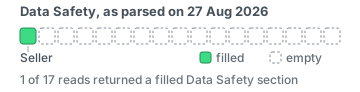
50+ · Free · released on Play Aug 14, 2026 · by Ruben Alfonso · Contains ads: No · checked 27 August 2026
Google Play listing · read 27 August 2026
Pile is a document manager from Ruben Alfonso, a developer publishing under his own name, and it reached Google Play on August 14, 2026. The idea fits in one sentence. Instead of filing documents into folders, you tag them into "piles", and a document can belong to several piles at once. Play lists it under Tools. At our read of the listing on August 27, 2026 it showed 50+ installs and no published rating, which is what thirteen days on the store looks like for a one-person app with no marketing behind it, and it is the baseline for almost everything on this page.
The listing's pitch is the tag system: "Built around a flexible tag system called 'piles', the app lets you categorize your documents the way you think, not the way folders force you to." It names PDF viewing, built-in search, and Material Design, and calls the app "100% offline". The strongest paragraph on the page is the privacy one; read August 27, 2026, it runs: "Pile does not collect any personal data. No analytics. No tracking. No cloud uploads. Everything stays on your device, under your control." The suggested audience is concrete too: "Students managing notes, assignments, and study materials" and "Professionals organizing contracts, invoices, and reports". The technology section adds that the app "is built using the latest Android development standards, including Jetpack Compose and Material Design", and the page closes on a tagline that doubles as the whole thesis: "Your documents. Your way. Your device."
What separates Pile from the usual privacy talk is that its claims line up with the parts of the listing the developer has to declare to Google. The Data Safety section, read the same day, states "No data shared with third parties" and "No data collected". Description and declaration agree. In this month's cohort of new releases, that agreement is the exception, not the rule. Two more checkable facts point the same way. The privacy policy linked from the listing sits on the developer's own GitHub Pages site, and the same package is published on F-Droid, where our sourcing pass found it on August 27, 2026. F-Droid distribution ordinarily means the source is public and the app can be built by someone other than its author, which is more third-party scrutiny than most new Play apps ever get.
The money side is simple and slightly worrying in its own way. On August 27, 2026 the listing showed a Free install button, no ads label, and no in-app purchases. There is nothing to pay for. That also means nothing visibly funds this app except the developer's own time, and the support contact on the listing is a personal Gmail address. One person, no revenue line, your documents. That is the honest shape of the deal.
What the listing does not say matters more here than usual, because the app's whole argument is local-only storage. The roadmap section makes part of the confession itself: "Backup options" is listed as a planned feature, which means backups are not a feature now. Local-only plus no backup has one failure mode, and it is total: if the phone is lost or dies, the piles go with it, unless you have moved copies off the device yourself. The listing describes no export flow. It does not say which file types get in-app viewing beyond PDF. It does not mention encryption at rest, an app lock, or a biometric gate, which are reasonable asks for the contracts and invoices its own copy invites you to store. The remaining roadmap items, "Local AI-powered document information extraction" and "Multiplatform support", are promises, not features, and this page treats them as exactly that.
Who should try it: anyone who wants a local, no-account shoebox for PDFs and paperwork, sorts by topic rather than by folder tree, and is comfortable being their own backup department. F-Droid users get the same package with the audit trail that store brings. If your actual need is reading and annotating PDFs rather than organizing them, the established options are in our PDF reader roundup. Who should skip it: anyone who needs sync between a phone and a tablet, automatic backups, or shared access, because the listing offers none of those today, and anyone whose documents are irreplaceable enough that a roadmap promise is not an acceptable substitute for a backup button.
The open question: whether a free, one-person app still ships its promised backup option after a month of real users trusting it with the only copy of their paperwork.
SSH for coding agents
10+ · Free · in-app purchases $5.99 to $39.99 per item · released on Play Aug 25, 2026 · by BOB Global · Contains ads: No · checked 27 August 2026
Google Play listing · read 27 August 2026
Redock is an SSH terminal for phones whose actual pitch is not the terminal. It is the app you leave open to supervise an AI coding agent running on a machine you own. The publisher is BOB Global, an account whose Play page shows exactly this one app, and the release date on the listing reads August 25, 2026, two days before our read on August 27. At that read: 10+ installs, no published rating. This is as day-one as a review subject gets, and everything below argues only from what the listing commits to.
What it commits to is specific. Read August 27, 2026, the listing promises: "When you are away from your desk, Redock helps you reconnect to your own SSH host" and pick up work "without opening your laptop". The use case is stated with unusual honesty about where phone terminals actually get used: "When you are outside, on the couch, or in bed, you can use your phone to check a remote session, steer a coding agent, or continue a task." The agent angle is explicit: "Redock works well with terminal based AI coding tools such as Claude Code, Codex, OpenCode." The concrete features named are "Native tmux support lets you resume sessions without remembering complex commands", an agent-aware interface with "smooth scrolling and CJK input, voice input", and project-scoped command shortcuts. The listing also draws its own boundary, and this is the most trustworthy sentence on it: "But it is not a hosted cloud IDE or a standalone AI coding app. Your code, credentials, and commands stay in the environment you configure."
Now the pedantry, because the listing earns some. The app is named "Redock - SSH / Mosh Terminal", and Mosh is the headline reason to want a phone terminal at all: it is the protocol that keeps a session alive across network switches and dead spots, the exact conditions of couch, street, and train. The description never uses the word Mosh once. It appears in the title and nowhere else on the listing. For the feature that would separate Redock from Termius and JuiceSSH, one word in a title is branding, not documentation. The listing English is also rough in places; one sentence reads "return to the right project check what is running", missing its comma. Small thing, but a listing this young is the only surface we can judge, and it has not been proofread.
The price reality, read August 27, 2026: free to install, no ads label, and in-app purchases from $5.99 to $39.99 per item. The listing does not say what any of those prices buy. No tier names beyond a passing "PRO purchase" in the What's new notes, no free-versus-paid feature list, and nothing anywhere on the page saying what the paid items contain. A $39.99 top item in a terminal app is either a lifetime unlock or a serious subscription, and a buyer has no way to know which before installing. That is the bluntest con here: the money is disclosed by the store and undocumented by the developer.
The Data Safety section, read the same day, declares "No data shared with third parties" and "No data collected". For an app that will hold SSH credentials to your machines, a zero-collection declaration is the right answer, and it is consistent with the listing's own claim that your code and credentials stay in your environment. It is still a self-declared form, not an audit, and with 10+ installs there is no user record to weigh it against. Neither is there a developer record: this is BOB Global's only Play app, and the support contact on the listing is a personal Gmail address rather than an address at redock.dev, the site the listing links.
Who should try it: someone already running Claude Code or another terminal agent on a box they control, who wants a phone-sized way to check on it and answer its prompts, and who treats the first paid item as the cost of finding out what the paid items are. The described tmux resume plus project shortcuts are exactly the missing piece for that person. Who should skip it: anyone who needs a documented, proven terminal today rather than a promising two-day-old one. The established utilities live in our tools and utilities hub, and the adjacent question of actually writing code on Android is covered in the code editor roundup.
The open question: whether a month of real users gets BOB Global to document the two things its listing currently leaves blank, what Mosh support actually covers and what the $5.99 to $39.99 items unlock.
Desktop agent remote
Among August 2026's new AI assistants, the pick is Cindy, XD Entertainment's phone-side remote control for a desktop agent, the only one of them whose Data Safety form spells out what leaves your device. For the best established productivity apps, see the productivity hub.
0+ · Free · released on Play Aug 25, 2026 · by XD Entertainment Pte Ltd · Contains ads: No · checked 27 August 2026
Google Play listing · read 27 August 2026
Cindy - AI Assistant is the phone half of a desktop AI agent. The agent runs on your computer, in the listing's words "operating files, browsers, and apps to actually finish your work, not just answer questions", and the Android app is its remote control: you dispatch tasks by text or voice, watch progress, and approve or reject what the agent wants to do. The publisher is XD Entertainment Pte Ltd, and the listing's own privacy policy link points at protocol.xd.com, the corporate domain of XD Inc., the games company behind TapTap. A games publisher shipping a desktop-agent controller is the oddest corporate fact of the month, and also a reason to pay attention: this is a large named company, not a shell account. The release date on the listing reads August 25, 2026. At our read on August 27, 2026 the install count was 0+, with no published rating. Nobody has been here yet.
The listing opens with "Consider it done." and promises real oversight, not just chat. On August 27, 2026 the page read: "Every task running on your computer, mirrored to your phone in real time", including "What she's doing, how far along she is, what it costs". The approval gate is described concretely: "When something matters, Cindy stops and asks: deleting files, sending messages, executing a plan." Scheduled work gets named examples, "daily issue triage, weekly reports, competitor monitoring". And the trust section makes three strong claims: "Your sessions and data live on your own computer", "the phone keeps no copy", and "The Cindy client is fully open source and auditable."
Now put the marketing copy next to the form the developer had to file with Google, both read the same day. Cindy's Data Safety section is the fullest disclosure among the month's new AI assistants, and that cuts both ways. The summary declares that the app may share data with third parties, and the detail page spells out five categories: in-app messages, other user-generated content, files and docs, voice or sound recordings, and photos, each marked as shared for app functionality. The collection list adds name, email address and user IDs for account management, and marks files, audio, and app activity as optional collection for analytics. "Data is encrypted in transit" and "You can request that data be deleted" are both declared.
Hold the two texts together. The description says your data lives on your own computer and the phone keeps no copy. The form says the app may share your files, your voice recordings, and your photos with third parties. Both can be true at once: files can live on your computer right up until a task sends them through a model API, and for an agent that works through AI models, the third parties are presumably model providers. But presumably is doing all the work in that sentence. The listing never names a model, a provider, or a processing location. It does not say whether you bring your own API keys or buy access from XD. It does not say where the sharing stops.
The money is the same shape of silence. On August 27, 2026 the listing showed Free, no ads label, and no in-app purchase range. Yet the listing's own dashboard copy promises to show you "what it costs" per task. Costs in what? Credits, a subscription, a metered API bill? Play says nothing, which for an agent that consumes model inference on every task is the single most practical unknown. The open-source claim has the same gap: "fully open source and auditable" is quoted above, but the listing links no repository and names no license. The only link is cindy.app. From Play alone, auditable is an adjective, not an address.
Who should try it: someone who already runs a desktop agent, wants a phone-side approval gate in front of file deletion and outgoing messages, and will read the privacy policy at protocol.xd.com before connecting it to that agent. The oversight design the listing describes, live progress, explicit approval, reject-and-redo, is genuinely the right shape for supervising an agent. Who should skip it: anyone who read "lives on your own computer" and stopped there, because the Data Safety form tells a wider story, and anyone who will not run an app whose operating cost is undisclosed at install time.
The open question: what a month of real tasks actually costs, and who the third parties in the Data Safety form turn out to be, since the listing answers neither today.
Paired AI chat
0+ · Free · released on Play Aug 24, 2026 · by playmore, Inc. · Contains ads: No · checked 27 August 2026
Google Play listing · read 27 August 2026
Loom Agent is an AI chat app from playmore, Inc. that becomes something more specific when paired with its desktop program. The listing says so itself, with candor worth quoting: "Loom Agent is an AI agent that you can ask anything. Up to this point, it is just like any other AI app." The difference arrives with the pairing: "if you connect it to the Loom desktop on your home or office computer, you can directly assign tasks to that computer", with the listing's own example being "Organize last month's sales CSVs and create a profit and loss Excel spreadsheet." One housekeeping note first: this Loom has nothing to do with the screen-recording tool of the same name that Atlassian owns. The developer's site is loomm.ai, double m. Launching in 2026 under a name a much bigger product made famous is a discoverability handicap this app chose for itself. The release date on the listing reads August 24, 2026, and at our read on August 27, 2026 it showed 0+ installs and no published rating.
The mechanics, as the listing describes them, are tidy. Pairing is one QR code: "Scan the QR code on your desktop Loom once, and that's it." You can open workspace files from the phone, get push notifications "when work is finished or needs verification", and there is an approval step: "Review and approve changes before editing files". The security claims are the strongest text on the page, and on August 27, 2026 they read: "The connection between your phone and desktop is end-to-end encrypted. Relay servers cannot view the content being exchanged, and no separate account or password is required for pairing." And on files: "Files on your computer remain on your computer". For organizations there is a one-line teaser, "ask about company tasks", answered by "a dedicated agent tailored to your questions".
What the listing does not say starts with the models. The only model language on the page is "You can personally select the model and inference strength (Fast/Smart)." Fast and Smart are speeds, not providers. No model is named, no provider, no bring-your-own-key option, no processing location. And nobody visible pays for any of it: on August 27, 2026 the listing showed Free, no ads label, and no in-app purchase range. Chat "on any device" means inference running on someone's servers at someone's expense, and the listing does not say whose. The organizational tier implies a business model exists; Play carries no price for it. When an AI app is free with no disclosed revenue, the cost has not disappeared. It is simply somewhere you cannot see from the listing.
Then there is the Data Safety section, and here Loom Agent makes the boldest claim of the month's AI cohort. The form, read August 27, 2026, states: "The developer says that this app doesn't collect or share any user data." No data collected, no data shared, zero categories. Now read the description again: "Conversations remain in your account and continue on any device." An account you log into, holding your conversation history, syncing it between devices, is user data on any plain reading of the words. Google's Data Safety rules do allow narrow exemptions, end-to-end encrypted transfers and ephemeral processing among them, and the phone-to-desktop relay the listing describes may genuinely qualify. Account-stored chat history is much harder to fit through any of them. So either the declaration leans on an exemption the listing never explains, or the form has not caught up with the app it describes. A reader cannot tell which from Play, and that uncertainty is itself the finding.
The contrast with Cindy, reviewed earlier in this section, is instructive. Cindy's Data Safety form discloses more data movement than its marketing copy admits. Loom Agent's form discloses less than its own feature list requires. Between the two failure modes, over-disclosure is the safer one to live with, because it at least tells you what to worry about. A zero-collection declaration on a cloud-account chat app is not a privacy feature. It is a question mark stamped where the answer should be.
Who should try it: someone who wants the QR-paired desktop delegation, is curious about the approval flow, and will treat the encryption and zero-collection statements as claims to verify rather than facts to rely on. Who should skip it: anyone who picks apps by their disclosures, because this one's disclosure contradicts its own description, and anyone who needs to know what the service will eventually cost, because no number exists on the listing. At 0+ installs there is no user trail to lean on either way.
The open question: whether the no-data-collected declaration survives a month of real accounts with synced conversation histories, or gets rewritten to match the app it describes.
Arabic-first fitness
In health, August 2026 comes down to one name: Sierfit, an Arabic-first fitness and trainer-marketplace app released Aug 26, 2026, and the only health and fitness app on the US Play Store we could verify as a genuine August release. For the best established fitness apps, see Best Fitness Apps for Android.
0+ · Free · released on Play Aug 26, 2026 · by DR SOCIAL · Contains ads: Yes · checked 27 August 2026
Google Play listing · read 27 August 2026
Sierfit is a fitness app from a developer called DR SOCIAL, filed under Health and Fitness and released on Google Play on Aug 26, 2026, one day before we read the listing. On Aug 27, 2026 the install counter stood at 0+ and no rating was published, which for a one-day-old app is not a criticism, it is arithmetic. The developer operates a website at sierfit.com and a privacy policy at sierfit.com/privacy, and beyond those two pages has no track record on Play we can point to. What separates this listing from the usual day-one fitness app is scope: this is not a workout timer with a splash screen, it is an attempt at a full platform, with training, a trainer marketplace, nutrition and a social network in one package.
In its own words, read Aug 27, 2026: "Sierfit is an Arabic fitness app that helps you organize your training, track your progress, and access trainers and nutrition programs all in one clear experience." The training half is conventional and usefully specific. The listing promises that you can "Create your training program with days, exercises, and sets", log "weights, reps, and notes all in one active workout screen", and "Use the rest timer and resume your workout after closing the app or losing your connection", which is the kind of small, checkable engineering claim a review can hold an app to later. The exercise library ships "with names and categories in Arabic and English", and the app tracks history, progress and personal bests.
The ambitious half is the trainer marketplace, and it contains the sentence that deserves the slowest read on this page. The listing promises browsing trainers "by location, specialization, experience, and price", in-person or online plans, a private chat with your trainer, and then this: "Upload proof of payment and track the status of your order and subscription clearly." Proof of payment means the money moves outside the app, and you photograph the receipt. That is a normal arrangement in much of the region this app serves, and the listing is honest about the mechanism. It also means Google Play's billing and refund machinery has nothing to do with anything you pay a trainer through Sierfit. The trust relationship is between you and the trainer, with the app as a bulletin board.
The nutrition side offers manual meal plans or "an AI-powered suggestion", a BMR calculator, and weight and body fat tracking that is shared with your trainer "after your approval". The listing then does something few day-one listings do: it states its own limits. The suggested nutritional values, it says, "are estimates and are not a diagnosis or prescription; they should be reviewed according to your individual needs."
As of Aug 27, 2026, Sierfit is free, lists no in-app purchases, and carries a Contains ads label. Read those three facts together: ads are the only visible monetization on the store side, and the actual business presumably lives in the trainer marketplace, which we already know runs on off-store payments. The Data Safety section, read from the listing the same day, declares no data shared with third parties, collection of "Personal info, Financial info and 6 others", encryption in transit, and that you can request deletion. Financial info collection is consistent with an app that asks for payment receipts. The content rating is Everyone with a Users Interact notice, which follows from the social layer: posts, photos, short videos, stories, follows, and clubs plotted on a map, with the listing noting that Sierfit "calculates the nearest clubs based on coordinates, without providing indoor routes".
What the listing does not say: which countries or cities actually have trainers in that browse list, how a trainer is vetted before appearing in it, what a plan typically costs, or who is behind the DR SOCIAL name. It claims an Arabic right-to-left interface with light and dark modes; an interface in any other language is not claimed, so treat the bilingual line about the exercise library as the extent of the English on offer. One behavioral signal does exist this early: the listing was already updated on Aug 27, 2026, with release notes written in Arabic, so someone is actively shipping.
Who should try it: Arabic-speaking readers who want training logs, trainer contact and nutrition planning in one app, and who go in understanding that paying a trainer by receipt upload is an arrangement with the trainer, not with Google. Who should skip it: anyone who wants an English-first tracker, anyone not prepared to hand personal and financial information to a platform that is one day old, and anyone drawn mainly by the social feed, which cannot be judged until there are people in it.
The open question: whether a month from now the trainer directory holds real, active trainers, or whether Sierfit is still a marketplace waiting for both sides to show up.
Pretend toddler phone
The best new app for kids in August 2026 is Tadidum: Toy Phone with Timer, released Aug 18, 2026, which turns a parent's phone into a pretend toddler phone whose fake battery ends playtime by itself instead of by argument. There is no evergreen kids roundup here yet; for the best established apps in the nearest category, parental controls, see Best Parental Controls Apps for Android.
50+ · Free · in-app purchases $7.99 to $35.00 per item · released on Play Aug 18, 2026 · by Kanily Technologies LLP · Contains ads: No · checked 27 August 2026
Google Play listing · read 27 August 2026
Tadidum: Toy Phone with Timer comes from Kanily Technologies LLP, a named limited liability partnership with its own site at tadidum.com and a privacy policy at tadidum.com/privacy. Play files it under Parenting with a content rating of Ages up to 5, and the record shows it released on Aug 18, 2026. On Aug 27, 2026 the counter read 50+ installs with no published rating, which nine days into an app's life means almost nothing either way. The idea fits in one sentence, and the listing's own summary supplies it: "Set a timer, hand your phone over, and let the pretend battery end playtime."
Its listing says, read Aug 27, 2026, that Tadidum "helps you turn your phone into a calm little pretend phone, with its own home screen, camera, dialer, and small apps to explore." Before the handover, the app "walks you through turning on screen pinning", which it says "keeps the phone inside Tadidum: your other apps, notifications, and gallery stay out of reach, so they can tap and swipe freely without ending up elsewhere on your phone."
The distinctive mechanism is the battery. The pretend phone has one, the parent decides how long it lasts, and the listing is specific about the ceiling: "There is no open-ended setting, and 60 minutes is the hard upper limit." When the battery drains, the app goes to sleep and only the parent can exit. The listing's explanation of why this matters is the best-written passage in this month's entire cohort: "From their point of view, nobody took the phone away. It simply ran out of battery and now needs charging." Whether that reframing actually works on a two-year-old is exactly what a store listing cannot prove. The listing offers the developer's own household as its only evidence, describing a daughter handing the phone back when the battery runs out, and a developer's anecdote about a developer's child is a design intention, not data.
The listing also commits to something rarer than a feature list: an absence list. "There are no points, streaks, badges, celebration animations, or autoplay. There is no endless stream of things to do next." The app is "meant to feel more like an offline toy than a kids' game, and to be easy to put down." Those are falsifiable commitments, and early reviewers will falsify them quickly if they are not kept. The mini-apps are described as practicing numbers and letters, matching, cause and effect, and fine motor skills, plus pretend calls, small photos, doodling and sounds, with no reading required. On the parent side, the listing promises control over which mini-apps are available, a sound toggle, playtime photos and past sessions, behind "a simple arithmetic check for grown-ups".
As of Aug 27, 2026 the app is free to install, shows no ads label, and lists in-app purchases from $7.99 to $35.00 per item. For an app aimed at children under five, the missing ads label is the most important line on the record, and Play's Data Safety section adds "Committed to follow the Play Families Policy". What the listing does not say is what the purchases buy. The description never mentions a paid tier, does not say which mini-apps sit behind the $7.99, and gives no hint what costs $35.00. That ceiling on a toddler app is not a scandal, but it is a fact better learned from this paragraph than from a receipt.
The privacy story is stated concretely and reads well: Tadidum "works without an internet connection", photos taken inside it "stay inside Tadidum and do not fill your gallery unless you choose to export them", and "There is no child account or profile. Optional analytics collect only general app-use data under a random installation ID and can be turned off." The Data Safety section, read the same day, declares no data shared with third parties, collection of App activity, and encryption in transit, plus one line that sits oddly beside the rest: "Data can't be deleted." If the only data collected is app-use activity under a random ID, a no-deletion answer is at least coherent, and declaring it plainly beats hiding it. It is still the line a privacy-minded parent should read twice.
One structural point the listing leaves implicit: the containment is Android's own screen pinning feature, not a lock Tadidum built. The listing promises a setup walkthrough. It does not promise that no child ever finds the unpinning gesture, and it could not honestly promise that, since pinning behavior is the phone's, not the app's. How that holds up across devices and determined toddlers is precisely what early parent reviews will document. Meanwhile the developer is visibly shipping: the listing was updated on Aug 27, 2026, and the What's new text announces importing photos and videos from the phone for the child to flick through, adding, in its own words, "They cannot delete anything!"
Who should try it: parents of under-fives who already hand the phone over sometimes and want the end of that time to stop being a negotiation. Who should skip it: anyone who needs monitoring, app blocking or web filtering, which is a different category solved by different tools, and anyone unwilling to install a children's app before knowing what its purchases contain.
The open question: whether the battery still ends playtime calmly in week four, when the novelty is gone, which only a month of real families can settle.
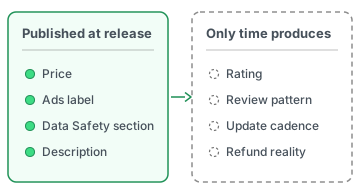
A page with a hard rule owes its readers the list of what the rule threw out. These are the apps August's coverage and store placement made look new, the ones a reader is most likely to arrive expecting. Excluding an app here is not a verdict against it; several of these are good apps having a good month. It is a verdict about the word new, and about what happens to that word when nobody checks a date. For each app below, the release date is the one its own US Play listing published when we read it during sourcing on Aug 27, 2026, and the reason for exclusion is one line long.
The method behind each date is the same one the main list uses: the released field on the live US listing, read twice at spaced intervals during sourcing, with the two reads required to agree. Where a rating or an install count appears below, it is the figure the listing showed on Aug 27, 2026, and install counts are Google's own rounded bands, not our estimates.
The month's biggest "new on Android" story: a note-taking app with sixteen years of iOS-only history finally arriving, with an early-August press push, a 4.0 rating, in-app purchases from $2.49 to $99.99, and 1,000,000+ installs already on the counter when read. Its Play released field reads Jul 28, 2026. The soft launch preceded the publicity by days, and days are what this page counts. Notability is a July app that had an August marketing month, and it belongs to July.
Sunbird's iMessage-on-Android relaunch was widely covered in early August 2026, and the app showed 10,000+ installs with in-app purchases from $2.99 to $24.99 when read. But its US listing publishes no "Released on" field at all; two separate reads during sourcing agreed on the absence, a pattern seen on early-access listings. A rule that reads the field cannot pass an app that does not publish one. There is also history worth remembering: Sunbird's earlier incarnation was pulled in 2023 after widely documented security problems with how it handled users' messages. An unverifiable release date on an app with that past is not a technicality.
The headliner of more than one "best new apps this August" roundup, and a genuinely interesting tool: it runs PC games locally on Android. Its released field reads Jul 2, 2026, a full eight weeks before the coverage calling it recently launched. It carried a 3.6 rating and 50,000+ installs when read. One more detail for the file: the developer field also reads "GameNative", the app-name-as-developer pattern that tells you nothing about who actually ships it.
Presented in an August roundup as a fresh launcher. The released field reads May 31, 2026, and the listing showed a 4.4 rating, 10,000+ installs and in-app purchases from $12.49 to $38.49 when read. A quarter-year on the store with a five-figure install base is a young app, possibly a good one, but it is not an August release by any reading of the record.
A year-view calendar picked up by August coverage, carrying a 4.4 rating and 500+ installs when read. The released field reads Feb 4, 2026. Half a year separates the record from the coverage, the widest gap among the nine near-misses named in this section, which makes Glance the cleanest illustration of why this page does not source recency from roundups.
The AI slide-maker's Android app appears in August best-new lists, and its listing showed a 4.7 rating with 100,000+ installs when read. The released field reads Jun 9, 2026. Popular, well-rated, and eleven weeks old by the end of August: a reasonable recommendation, and a wrong answer to the question this page asks.
An RSS widget from a named independent developer, paid $4.99 up front, with 10+ installs and no rating yet when read. Its released field reads Jul 30, 2026. That is two days short, and it stays out. A cutoff that stretches for sympathetic cases stops being a cutoff, and next month's page inherits whatever honesty this one practices; HomeFeed was July's app by 48 hours, and the bar is a bar.
Excluded on the date, flagged for the pattern. The released field reads Jul 27, 2026, so it misses on the rule alone. The rest of the record, as read during sourcing on Aug 27, 2026, deserves stating in full: 100,000+ installs accumulated within a month of release, against a 3.7 rating, on a listing that carries ads. Six-figure adoption in weeks paired with a mediocre rating is the shape a paid install campaign leaves rather than the shape word of mouth leaves; we cannot see a developer's marketing spend, so this stays an observation about numbers, all of them Google's own. Either way, July.
The one editorial exclusion. Split Easy's released field reads Aug 26, 2026, confirmed by two separate reads, so it meets the letter of the rule and is excluded anyway. At sourcing on Aug 27, 2026, the one-day-old listing published a title and a Finance category and essentially nothing else readable, with the install counter at 0+. The developer's account publishes nine unrelated apps, among them one built around Rife frequency "healing", a genre of health claim with no scientific standing; a portfolio of disconnected apps spanning expense-splitting and frequency healing is the shape of template publishing, not of a developer behind a product. The field date gets an app considered, not recommended, and we would rather name the judgment here, with reasons, than list the app above with hedges.
Two traps recur beyond these nine and deserve naming as classes. The year trap: a listing whose field reads the right month of the wrong year, like the password manager whose field reads Aug 20, 2025, twelve months off a casual glance. The name trap: an app named for the current year whose field reads Sep 7, 2016, a decade-old product refreshed annually in title alone. And the null trap, rarer but sharpest: listings that publish no released field at all, which no volume of coverage can substitute for. All three are why every date on this page is quoted in full, field to the day, alongside the day we read it.
The nine cases above are the ones readers will ask about by name. The sourcing pass that built this page checked far more, and the pattern repeats often enough to be worth printing in full. Every date below is the Play listing's own Released on field, read on 27 August 2026. Where coverage dates are given, they describe when the app was written about, which is a fact about the coverage, not about the app.
Announced in August, released earlier. Mesh, a contacts and CRM app, drew launch coverage dated 12 August; its field reads 1 July 2026, a quiet soft launch preceding the press one. Bingers, a TV and movie tracker, was covered as launching on 4 August; the field reads 23 July 2026, twelve days too early for this page. Wrinkles, an audio tour guide, appeared in the same wave; its field reads 30 March 2026. Loops, the fediverse short video app, was framed as newly arrived; the field reads 14 June 2026. Pictonico, Nintendo's photos into minigames experiment, launched to press in late May, and its field agrees: 19 May 2026. Gamma's slide maker and Glance's year view calendar both ride August roundups with fields reading 9 June and 4 February 2026. Playling, a language audio trainer, surfaced on 20 August; field, 4 July 2026. Mooneva, a private period tracker, was posted about on 12 August; field, 11 February 2026. Peach, an agentic assistant in an app digest dated 21 August, reads 27 July 2026. Nibble, a daily learning app in one August list, reads 13 May 2025, over a year old. A children's eating app in another August page reads January 2023.
No released field at all. Sunbird, the iMessage bridge, relaunched to everyone in early August by its own account, but its live US listing publishes no Released on field, and this page's rule needs one. Its 2023 security history is widely documented and is not re-litigated here; the absence of the field is disqualifying on its own. Mechanly, an August pick elsewhere, publishes no field, no rating, and reads like an early access shell by its own record.
Renames and updates wearing a launch costume. Snapseed 4.0 is the year's biggest photo editing story and it is an update to a package first released in 2012; it belongs to its own roundup, not here. The Fitbit app's rebrand toward Google Health sits on a package whose field reads March 2012. Grok Imagine's image model refresh in early August happened inside an app released in 2025; a model update is not an app release. Google Password Manager's standalone listing, which surfaces in new password manager searches, reads August 2025, one year off. The starkest case is an app named 2026 Keyboard whose field reads September 2016: a decade old package under an annually refreshed name, from a developer account named for the coming year. The name promises new; the field remembers.
Not verifiable on Play at all. Zesty, the restaurant discovery app, remains outside Android at the time of writing, with coverage saying an Android version is expected; the similarly named package on Play is unrelated to it, which is exactly how namesquatting works. X Money is a feature inside an existing app, not a listing, and the closest match on Play is again an unrelated app wearing the name. Outernet's coverage dates to early August, but Android access sits behind a waitlist and the one Play result under that name belongs to someone else. Adobe Premiere deserves its own line: a listing exists on US Play under Adobe's name, installable today, with no published rating; its field does not read August, and the long promised phone version's real arrival will be a story for the month its field names. Howdy, a small ad free streaming service, launched its Android app in the spring by every account this page could not open, and no read was spent proving a date the field would have to carry anyway. Aptoide Games became the first rival app store distributed through Google Play in the United States in August, which is genuine August news about distribution, not an app release this page can date from a listing field.
One search wave, five old apps. A single August search cluster for AI music video makers surfaced five apps whose coverage read new and whose fields read otherwise: Yuna, March 2026; 1MS, May 2025; Solmi, December 2025; Sondo, April 2025; and MAIVE, May 2024, two years old and still riding the wave. Two of the five carry keyword stuffed developer names, which is its own answer. The lesson generalizes: when a category gets hot, its listings age backwards in the coverage, and only the field remembers.
None of these are accusations. Most are ordinary soft launches, staged rollouts and rebrands, and the coverage that followed them was mostly right about everything except the word new. But a page called best new apps has to mean something by new, and the only definition a reader can check in ten seconds is the one printed on the listing.
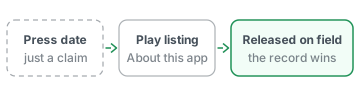
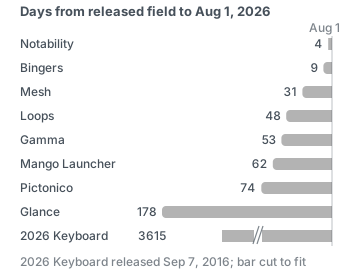
Every app on this page was checked the same way, and nothing in the method needs special tools. It takes about three minutes per app, entirely on the Play listing.
Start with the Released on field, under About this app. It is the only date on the listing that cannot be refreshed by a routine update, and it settles the word new before anything else gets a vote. Then tap the developer name. The account's other apps are its track record: a first app deserves patience, a portfolio of keyword named clones deserves none, and an account that has shipped steadily for years is quietly the strongest trust signal a listing can carry.
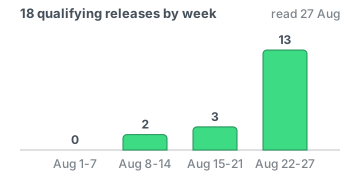
Read the Data safety section literally, the way this page does. It is a form the developer fills in, printed as given, and on week old apps it is where honesty and sloppiness both show first. A declaration that contradicts itself is worth taking at its written word until the developer corrects it, because the written word is the only commitment on record.
Then read What's new, not for the features but for the tone. A day one listing that says what just changed and what is still rough is being run by someone who expects to be read. Finally, treat the absence of a rating as information rather than as a gap: it means the app is young enough that nobody can tell you how it holds up, including the person who wrote the listing, and including this page. That is not a reason to stay away. It is a reason to know exactly what you are agreeing to while the record is still being written.
Only apps whose US Google Play listing publishes a "Released on" field reading August 2026, verified against the live listing on Aug 27, 2026. Press launch dates, relaunches, rebrands and major updates do not count, and an app whose listing publishes no released field at all cannot qualify, because the claim cannot be checked.
Google Play does not display a rating until an app has enough ratings, and most of this cohort is days old. As of Aug 27, 2026, 16 of the 18 qualifying apps had no published rating, and those sixteen all showed install counters between 0+ and 100+. That is not a defect of the apps; it is what genuinely new looks like.
The coverage peaked in August 2026, but the app's own Play listing publishes a released field reading Jul 28, 2026. The store record is this page's only source of release dates, so Notability belongs to July, and it is discussed in the named exclusions section.
No, and the page does not pretend to. Every claim is verified against what Google Play published on the read date shown in each review: the app's own description, price, ads label, in-app purchase range, Data Safety declarations and install counts. Verdicts about daily reliability need weeks of real users by real users, which apps released in August 2026 have not had yet.
It is a bigger leap than installing an established app, and the page treats it that way. Before installing, read the listing's Data Safety section, check for an ads label, check the in-app purchase range, and look at what else the developer publishes. Each review here states exactly those facts as of Aug 27, 2026, plus what the listing does not say, which is often the more useful list.
Released on is the date the app first became available on Google Play; Updated on is the date of its latest build. Only the released field decides inclusion here. The gap matters in both directions: Sierfit released Aug 26, 2026 and had already updated by Aug 27, 2026, while one keyboard app named for 2026 publishes a released field reading Sep 7, 2016.
No. Within this page, release dates span Aug 11, 2026 for Seller by Meta to Aug 26, 2026 for Fabled and Sierfit. The fact line at the top of each review carries the exact released date and the date we read the listing, so you always know how old the record was when the words were written.
It is rebuilt monthly around the same rule. The September 2026 edition will apply the identical test, a released field reading September 2026, and the apps on this page will by then have real ratings and install histories, which is when their open questions get answers.
Checked 27 August 2026: first publication. Eighteen Play listings with an August 2026 released field were read at the United States storefront; seventeen are reviewed above and Split Easy is named in the exclusions with the reason. Ratings exist for two entries only and are printed where they exist. Review counts are deliberately not printed anywhere: they drift daily.