Updated August 2026 · both records re-read at their own source on 20 August 2026, and each entry taken to its own developer, which dates a build for one of the two
This page reports what two catalogues publish about two camera apps on one date, and how current each entry is at whichever source can date it. It does not describe how either app behaves, because nothing here rests on running them. Where a catalogue has no such field, the page says so.
Blackmagic Camera is our pick for a full store record, because its Play listing, read 2 September 2026, gives 4.6 from 13,846 ratings, free, no ads label.
MA Camera is our pick for published source code, because its F-Droid page, read 2 September 2026, gives 2.6.5 under GPL-3.0-only with no price or ads label.
Blackmagic Camera is our pick when current beats new, because its Play record was updated 29 July 2026 over a 3 June 2024 release, still free with no ads label.
Data checked: 3 September 2026.
The monthly umbrella for this series is best new apps for Android, where every entry is dated by its own Play release field.
Best for a record you can check in full
Released 3 June 2024 in its own Play record, so not a 2026 arrival, against a listing update of 29 July 2026 · Rating 4.6 from 13,846 ratings · Installs 1,000,000+ · Free to install, no in-app purchases · Developer Blackmagic Design Inc. · Data Safety: no data shared with third parties, and the app may collect some data types · Contains ads: No · checked 2 September 2026
Google Play listing · 4.6 (13,846) · read 2 September 2026
Blackmagic Camera is current, and it is not a 2026 arrival: its own Play record, read 2 September 2026, dates its release to 3 June 2024, and its listing carries an update on 29 July 2026. What that listing publishes is a rating of 4.6 from 13,846 ratings, an install band of 1,000,000+, a free install with no in-app purchases, no Contains ads label, and a Data Safety section whose middle line says the app may collect some data types. A store record is not a review, and none of it describes how the app behaves.
The developer publishes the app under its own name. Its product page describes it, in the developer’s own words, as an app that unlocks the power of your iPhone, iPad, Android phone or tablet by adding Blackmagic’s digital film camera controls and image processing!
, quoted from the Blackmagic Camera product page, read 20 August 2026. That page links the same Play package this page links, which is how the listing was confirmed to be the developer’s own rather than a repackage, and it publishes no version number or minimum Android version either. Its Data Safety section carries three lines, quoted as the listing states them: no data shared with third parties, this app may collect these data types, and data is encrypted in transit. The middle line matters, and may is the listing’s own word, so it is not a statement that nothing is collected. Skip this if published source code matters to you more than a published record: the other entry on this page is the one whose licence and repository are open to reading.
Best for published source code
Version 2.6.5, build 20260804, added to F-Droid on 10 August 2026, two releases behind its own developer · Licence GNU General Public License v3.0 only, SPDX id GPL-3.0-only · Requires Android 12 or newer, arm64-v8a only, 13 MiB · No rating, no review count, no install count, no price and no Contains ads label are published, and there is no Data Safety section · The record read for this page lists no Anti-Features · F-Droid page, read 20 August 2026
F-Droid page · no rating is published there to quote · read 20 August 2026
MA Camera is being worked on, and the build you can install from F-Droid is behind the one its developer has published. F-Droid's suggested build, read 20 August 2026, is version 2.6.5, added to the repository on 10 August 2026, and the developer's own releases page, read the same day, dates that same version to 4 August 2026 and has published two releases since, 2.6.6 on 10 August 2026 and 2.6.7 on 17 August 2026. F-Droid publishes no rating, no review count, no install count, no price and no Contains ads label for it, because it publishes none of those for any app.
Those two dates for one build are the point, and they are six days apart. A date F-Droid prints beside a version is the day that version entered the repository, not the day it was released, so it cannot be read as a release date here or anywhere else. The match is not guesswork: F-Droid gives the build code 20260804 for 2.6.5, and the developer's own release notes for 2.6.5 give the same build code. Each of the three releases named above carries a camera build among its files, so the newer ones are not releases this app sat out.
Its F-Droid page sums the app up, in the developer's own words, as The most featureful open-source Camera app
, quoted from that page, read 20 August 2026. That is the project's claim about itself, and this page cannot confirm it. Being open source is not a privacy guarantee, an ad-free guarantee or a quality guarantee either. The licence is a fact; what a reader reads into it is not. Skip this if you want a published rating, price or ads label before you install anything: the other entry on this page is the one with a full store record.
The two entries are documented to different depths, and that difference belongs to the catalogues rather than to the apps.
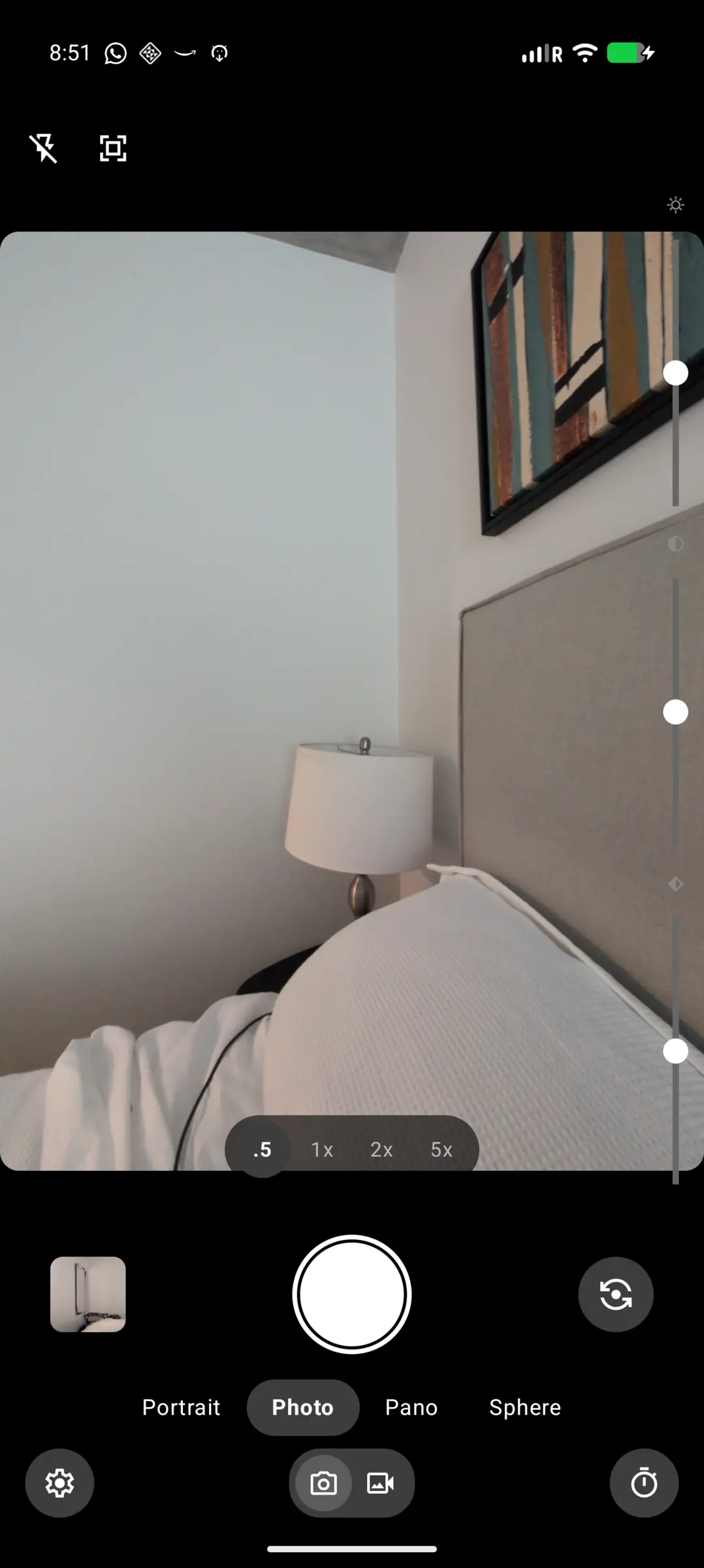
Google Play publishes a rating and a review count, an install band, a price, an in-app purchase range where the app has one, a Contains ads label where the app carries advertising, a release date and a Data Safety section. Its answers for Blackmagic Camera are in the section above, each with the date it was read. F-Droid publishes none of those fields, for any app it carries. What its page for the other entry does carry, read on 20 August 2026, is the app name, the developer's summary and description, the author, the licence, the three most recent builds with the date each was added, the minimum Android version, the architecture, the download size, the permissions each build requests, the signature and build log, a donation link, the one screenshot the project published, and links to the source code and the issue tracker.
One of those flags does answer an advertising question, though not the way a store label does. Ads is an Anti-Feature, and F-Droid's own Anti-Features documentation, read on 20 August 2026, glosses it simply as advertising; no Anti-Feature is listed for the entry here. That is the absence of a warning, not a finding that the app shows none. So the second row of the table is not hiding anything, and its merged cell is not a bad score: where nobody publishes a number there is no number to quote, and a rating nobody publishes is not a poor one. The same goes for the licence. Being open source is not a privacy guarantee, an ad-free guarantee or a quality guarantee, and anything read into it beyond the licence text is inference rather than fact.
Now the freshness rule, which this page leans on harder than any other, because its title says 2026. A record that has not been updated for more than eighteen months is called out on this site as stale, and neither entry is anywhere near that line. Beyond that the two catalogues disagree about what they are even measuring. Blackmagic Camera carries two dates: its own Play record dates the release to 3 June 2024, and its listing carries Play's Updated on date of 29 July 2026, the day the app was last updated on the store. So it is current, and it is not a 2026 arrival. MA Camera's F-Droid page carries a date that is neither of those, the day a build was added to the repository, and on 20 August 2026 that build was 2.6.5, added on 10 August 2026 and released by its developer six days earlier. So one is Play's own Updated on date for the app, one is the day a build entered a repository, and only the developer's own releases page dates a release. Checked against that page on 20 August 2026, the app is current and the repository is two builds behind it.
What this page cannot tell you is how old MA Camera itself is. The nearest first party date is the repository the build ships from, github.com/vayun-mathur/Modern-Apps, which was opened on 15 January 2026, read on 20 August 2026, and which its own description calls a full mobile ecosystem of 36 apps. That dates the repository, not this app inside it, so it is the earliest date this page can put on the code and not a founding date for the camera app. No source read for this page dates the app itself, and the page says so rather than turning a repository date into a project age.
That is also why this page does not rank the two on how new they are. Neither catalogue publishes a figure that would support it, and the one source that does, in each case, is the developer writing about itself.
It comes down to which kind of evidence you want before installing anything.
Take Blackmagic Camera if you want a record you can check in full. Its Play listing answers the price, ads label, rating, release date and Data Safety questions above, each dated in its section, though not the version or the minimum Android version, and neither does the developer's own product page. Accept in exchange that a Data Safety section is a declaration by the developer rather than a measurement, that its middle line says the app may collect some data types, and that a 2024 release is what you are installing.
Take MA Camera if published source code matters to you more than published paperwork. It is under the GNU General Public License v3.0 only and its F-Droid page links the repository, so the code can be read by anyone who wants to. Accept in exchange that F-Droid publishes no rating, no price and no Contains ads label for it, so there is nothing of that kind to check, that the build it offers requires Android 12 or newer on a 64 bit ARM device, that the same build is two releases behind the developer's own, and that the line selling it is the developer's own summary.
Neither choice is a recommendation about image quality, and this page does not make one: nothing here rests on running either app. For a wider shortlist of camera apps, see our best camera apps for Android roundup.
This page used to carry five write ups and a closing section on what stayed quiet. It now carries two entries, and that is worth explaining rather than papering over.
An entry here needs a first party record: the app's own listing or catalogue page, re-read on the day of writing, with the date printed beside every figure, and a developer source that can be opened to check whether the entry is still current. Two of the entries this page once carried have one and are still here. The others rested on news coverage, a download mirror, a developer changelog with no store page beside it and, in one case the page itself admitted to, a version string from a search snippet, and the version of the page they were withdrawn from linked no store page for any of them. Every entry that went is named in the changelog at the foot of this page, with the reason it went. That reason was about what this page could open and read, not a finding that those apps have no record anywhere.
Two entries is a thin year for a category this size. Saying so is more useful than filling the gap with apps the page never linked, and the shortlist above is the honest place to send anyone who wants more of them.
Yes, free to install, and its Play listing shows no in-app purchases and carries no Contains ads label. Its Data Safety section declares that no data is shared with third parties and that the app may collect some data types, which is a declaration by the developer rather than a measurement. Checked 20 August 2026.
Its F-Droid page does not answer that the way a Play listing does, because F-Droid publishes no Contains ads label for any app it carries. What it has instead is the Ads Anti-Feature, one of the warning flags set out in F-Droid's own Anti-Features documentation, which is linked in the section on what each catalogue publishes and which glosses that flag as advertising. On 20 August 2026 the package page listed no Anti-Features at all for MA Camera. An absent warning is not a statement that the app shows no advertising. Checked 20 August 2026.
Because F-Droid publishes no rating, no review count and no install count for any app, and no price or Contains ads label either. Google Play publishes all of those, which is why the other row has a value in those columns. The gap is a property of the two catalogues, not a finding about MA Camera. The last column of the table, how current each entry is and when that was checked, is filled for both rows, because it is the one thing both sources answer. Checked 20 August 2026.
Not on 20 August 2026. F-Droid offered version 2.6.5, added to the repository on 10 August 2026, while the developer's own releases page listed 2.6.6 from 10 August 2026 and 2.6.7 from 17 August 2026, each with a camera build among its files. The date F-Droid prints beside a version is the day that build entered the repository, not the day it was released: 2.6.5 was released six days before F-Droid added it. Checked 20 August 2026.
Neither is straightforwardly new, and this page ranks nothing. Blackmagic Camera's own Play record gives a release date of 3 June 2024 against a listing update of 29 July 2026, so it is current rather than new. For MA Camera the honest answer is narrower than this page used to give: the nearest first party date is the repository the build ships from, github.com/vayun-mathur/Modern-Apps, which was opened on 15 January 2026 and which its own description calls a full mobile ecosystem of 36 apps, so that date belongs to the repository rather than to this app inside it. No source read for this page dates the camera app itself. What its F-Droid page dates to 10 August 2026 is not a release either, it is the day that build was added to the repository. Checked 20 August 2026.
Checked 20 August 2026: Both records were re-read at their own source and both entries were then taken to the developer behind them, which is the column this page leans on and the one that was missing. That check is not symmetrical, and the page no longer implies it is: MA Camera's developer publishes dated releases, which is what dates a build, while Blackmagic's own product page confirms the Play listing is the developer's own but publishes no version and no date to check currency against. Blackmagic Camera's rating count moved from 13,316 to 13,457 against an unchanged 4.6, an unchanged 1,000,000+ install band, an unchanged free install with no in-app purchases and an unchanged absence of a Contains ads label. New to the page: the release date its own Play record carries, 3 June 2024, which the page had never printed and which the title alone invited a reader to guess wrongly, and a verbatim line from the developer's own product page, which links the same Play package this page links and which publishes no version number either. MA Camera's entry gains the build code F-Droid shows for 2.6.5, the download size and the architecture, which is arm64-v8a only and excludes every 32 bit device, and the finding this pass turned on: the developer's own releases page dates 2.6.5 to 4 August 2026, six days before F-Droid added it, and has published 2.6.6 and 2.6.7 since, so the build the repository offers is two releases behind. The claim that what F-Droid offers is days old rather than years old was true and is now stated more precisely against the developer rather than against the repository alone. On the five entries withdrawn on 15 August 2026 and named below, one correction: that entry can be read as a finding that those apps have no first party record, and re-opening two of them today shows that is not what was established. Snapseed answers on its own Play listing under Google LLC, and Open Camera answers on the F-Droid API. What was established was narrower and still holds: the version of the page read that day linked no store page for any of the five, and no first party record was read for any of them in that pass. None is re-added here, because each would need its own currency pass. The screenshot strip for the F-Droid entry is unchanged and still sits in the section of the app it shows. One more correction, to a reading this page invited rather than to a figure it printed: the 2026 in the title covers the two entries differently, and the page now says which is which. A draft of this pass went further and called MA Camera a 2026 project on the strength of the 15 January 2026 creation date of the repository its build ships from. That is withdrawn before it shipped: the repository is a 36 app monorepo, so its creation date dates the repository and not this app inside it, and the page now says that, links the repository in the same sentence, and states plainly that no source it read dates the camera app itself. Also withdrawn from the same draft: the sentence calling Play's 29 July 2026 date a listing edit, which contradicted this page's own reading of it two sections earlier. It is Play's Updated on date, the day the app was last updated on the store. The verdict capsule was rebuilt to the owner's 2026-08-18 ruling: it is labelled Our answer, each of its three picks is one sentence with an app as its subject carrying its own reason and date, and it closes with the date the figures were read. The one decision table gains a sixth column, how current each entry is and when that was checked, which is the only column both catalogues can fill, and its Ads header now reads Ads label, because the column reports what the listing carries rather than what the app does.
Checked 15 August 2026: Blackmagic Camera was re-read from its own Play listing, which the live page linked without printing a rating, a rating count, an install band or an ads label from it: all of those were new to the page that day, alongside the Data Safety section, and the free price the page did state now carries the date it was read. Its version number, printed then as 3.4, is withdrawn: it rested on trade coverage and a download mirror rather than on the listing, and the record read from the listing carries no version at all. MA Camera was re-read from its F-Droid page, which gave version 2.6.5, added on 10 August 2026, in place of the 2.6.1 the page printed as current; the page now states plainly that F-Droid publishes no rating, no review count, no install count, no price, no Contains ads label and no Data Safety section, instead of leaving that gap for a reader to take as a clean bill of health. What it does publish is set out too: the permissions each build requests, the minimum Android version, and F-Droid's own Anti-Feature warning flags, one of which marks advertising and none of which is listed for this app. Retracted for MA Camera: it has no press coverage at all. That was an absolute, and its F-Droid page says nothing either way about press coverage. Withdrawn entirely, because that pass had no first party record for any of them and the version of the page read that day carried no store link for one either: Snapseed, VWFNDR MBL, Samsung Expert RAW, and the two entries the page carried as quiet, Google Camera ports and Open Camera. Their figures came from news coverage, a download mirror, a developer changelog and, in one case, a search snippet. The opening claim that Five things genuinely shipped goes with them. Also added: one decision table, since the page carried none at all, and a dated How we verify box naming both sources and stating what F-Droid does not publish. The verdict capsule was rewritten rather than added: the page already carried one naming five entries, three of which were withdrawn that day while the other two are the entries this page keeps. The FAQ was rewritten in full: four of its five questions were about entries that had gone, the fifth asked about method, which the How we verify box now answers, and two of the five carried first person wording. The screenshot strip for the F-Droid entry was kept unchanged, still in the section of the app it shows, with the caption naming who published it. The six Play marketing images the page carried for the other entry were dropped: the standard here allows no Play marketing graphics.