Updated September 2026 · the app now carries its own dated listing figures, and what the money buys sits in one table
This is a plain account of what changes when you pay: what the free tier withholds, which settings matter afterwards, and who should keep their money.
On demand play and offline downloads
4.3 stars from 36,236,769 reviews · 1,000,000,000+ installs · free to install · in-app purchases $6.99 to $203.88 per item · by Spotify AB · Contains ads: Yes · checked 3 September 2026
Google Play listing · 4.3 (36,236,769) · read 3 September 2026
The app is free to install and its own listing carries the Contains ads label, which is the free tier in one line: advertising pays for it. Premium is one of the in-app purchases on that same listing, which run $6.99 to $203.88 per item, and what it buys is on demand play, downloads and the ad break going away. The blunt con: the upgrade is a subscription rather than a purchase, so the moment it lapses the shuffle and the ads come back.
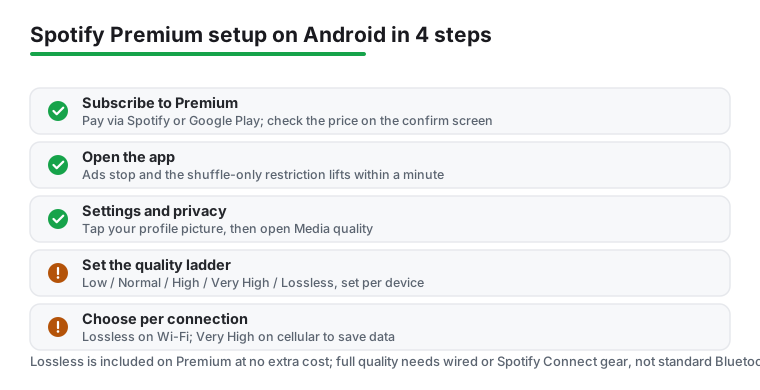
If you already have the free app from the Play Store, you do not reinstall anything to go Premium. Open Spotify, tap your profile picture in the top corner, and look for the Premium option. One thing worth knowing in 2026: the Android app now lets you pay through Spotify directly or through Google Play. The price can differ between the two, so glance at the total on the confirm screen before you tap buy rather than assuming one is always cheaper. Once payment clears, the app catches up within a minute, the ads stop, and the shuffle only restriction lifts.
The first thing to sort out on a fresh account is audio quality. Tap your profile picture, then Settings and privacy, then Media quality. You will see a ladder running Low, Normal, High, Very High, and now Lossless. The catch is that you set the quality separately for Wi-Fi, cellular, and downloads, and you have to do it on every device you use. A sensible split is Lossless or Very High on Wi-Fi, Very High on cellular, and Lossless downloads only if storage is not tight. Worth a warning: lossless over cellular is hungry, easily a gigabyte an hour, so it is best kept for Wi-Fi. The whole setup takes about five minutes and nothing about it is technical. If you share a household, the Duo and Family plans work out far better than stacking individual accounts, and everyone keeps their own library and recommendations.
A handful of things make Premium feel worth it in daily use. On demand play is the big one. Free Spotify keeps you shuffling most playlists and albums, which gets old fast when you just want one specific song right now. Premium lets you tap any track and hear it. Offline downloads matter almost as much for us. We load a few playlists the night before a flight, switch the phone to airplane mode at the gate, and the music plays with no data and no buffering. You can keep roughly ten thousand tracks downloaded per device across up to five devices, as long as you let the app check in online once every thirty days.
Then there is the quiet pleasure of no ads. On the free tier an ad break every few songs kills the mood, and it always seems to land mid workout. With Premium the music just runs. The newer reason to upgrade is lossless audio, which Spotify added to Premium in late 2025 at no extra cost. Spotify documents it as up to 24 bit, 44.1 kHz FLAC, and how much of that survives depends on the connection and the headphones. Worth being clear about the limits: standard Bluetooth cannot carry full lossless, so for the true version you want a cable or a Connect device that supports it, and lossless does not apply to podcasts or audiobooks.
A few small habits make Premium nicer on Android. Long press any playlist and pick Download so it is ready before you walk out the door. Add the home screen widget, which you get by long pressing your wallpaper and choosing Widgets, so you can skip a track from the lock screen without unlocking the phone. In the car, Spotify hooks straight into Android Auto and the big simplified controls are easy to glance at and get back to the road.
For better recommendations, use the heart button and the Like and Hide options honestly. The more you rate songs, the sharper your Discover Weekly and Daily Mixes get over a few weeks. Spotify Connect is worth learning too, because it turns the app into a remote for a speaker or TV on the same network, so you can queue music from the couch without getting up. If you want voice search, the microphone icon in the search bar still works for finding a song or artist by speaking. If you like the words on screen while a track plays, that pairs well with our roundup of apps that sync lyrics on screen.
Spotify is reasonable about Android permissions. It asks for storage so downloads can live on your device or SD card, notifications for the playback controls, and optionally microphone access, which these days is mainly for voice search in the search bar. Note that the old hands free Hey Spotify wake word is gone now, so you do not need the mic for that. You can decline the microphone prompt and still use everything else. Bluetooth and nearby device permissions only show up when you connect to a speaker. Nothing in that list is unusual for a streaming app.
The honest downsides are about cost and clutter, not privacy. Premium is one of the in-app purchases on the Spotify listing, which run $6.99 to $203.88 per item read 3 September 2026, and prices move with country and promotion, so it is not the bargain it once was. The app has also grown busier, pushing podcasts and audiobooks into a space some listeners would rather keep to music. And the lossless toggle, nice as the feature is, is fiddly: you have to set it per device and per connection, and the best of it needs wired gear because Bluetooth caps the quality. If you only ever listen on shuffle anyway, the free tier may already cover you. Premium earns its keep when you want control, offline play, and quiet between songs.
Premium is not the only good option, and some readers belong elsewhere. If you are deep in the Apple world with an iPad or Mac, the cross platform fit is better than you might expect, and we walk through it in our guide to Apple Music on Android. If you keep most of your music as local files and rarely stream, a dedicated offline player is cheaper and lighter, and it will not nudge you toward podcasts you did not ask for. And if the 2026 price bump stings, it is fair to sit on the free tier a while and see whether shuffle and ads actually bother you day to day.
To weigh Spotify against every major rival side by side, including free local players and other streaming names, start with our best music player apps for Android pillar. You can also browse the wider Music and Audio hub for podcast, equalizer, and recorder picks. For most listeners who want a huge catalog, lossless now included, and a player that simply works, Spotify Premium is still an easy recommendation in 2026.
It depends on one thing: whether you choose tracks or accept what plays. On demand play and offline downloads are what the money buys, and both are daily changes. If you listen at home on Wi-Fi and do not mind ad breaks, the free tier is the tier the listing describes. Checked 3 September 2026.
Either works, and the in-app route is the one on the listing, at $6.99 to $203.88 per item read 3 September 2026. Prices vary by country and promotion, so check what your own account is offered before committing. Checked 3 September 2026.
Yes, and it is the strongest reason to pay. Long press a playlist or album and choose Download while you are on Wi-Fi, and it plays with no connection at all. The free tier has no offline mode. Checked 3 September 2026.
Storage for downloads, notifications for the playback controls, and optionally the microphone for voice features. All three can be reviewed under Settings, Apps, Permissions, and declining the microphone leaves playback untouched. Checked 3 September 2026.
Checked 3 September 2026: the guide discussed the upgrade with no store link, no rating, no install band and no dated line. Two lines are withdrawn: the opening claim that Spotify Premium is the upgrade people ask us about most, and a price line saying the Individual plan now around 12.99 a month, replaced by the in-app purchase band printed on the listing itself. The app now carries a fact line read from its own listing, a store link and three pros and three cons, and a table sets the free tier against Premium row by row. The figures that matter for a page about paying: the listing carries the Contains ads label, which is what the free tier is, and the in-app purchases run $6.99 to $203.88 per item.