Updated August 2026 · both catalogues and both project release feeds re-read, and the comparison rebuilt around the column this category actually turns on: what each app deletes, and what it has to be granted first
Two Android storage apps, compared on the question a store listing does not settle: what each one removes from a phone, and how much of the phone it has to be given to do it. One of them is in both catalogues, the other in only one, and the difference between what the two catalogues publish is itself part of the answer.
For the standing shortlist across the whole category rather than a two entry check, the cleaner apps roundup covers the wider field.
SD Maid 2/SE is our best overall pick and the best free install here, because its Play listing, read 21 August 2026, rates it 4.2, carries no Contains ads label, and its in-app purchases run $3.99 to $7.99.
disky is our niche pick for measuring storage, because its F-Droid entry, read 21 August 2026, describes a filesystem analyzer and publishes no price or ads label.
Neither clears another app's cache unaided, because Google's permission reference, read 21 August 2026, marks CLEAR_APP_CACHE signature|privileged.
Data checked: 3 September 2026.
The monthly umbrella for this series is best new apps for Android, where every entry is dated by its own Play release field.
How to read these columns. What an app deletes is taken from the description its own developer published and from the permissions its own catalogue lists, not from watching either app work. Only the Play row uses the Ads column, and No there means that listing carried no Contains ads label on 21 August 2026: the label is a Google Play field and F-Droid has no counterpart to it, so the other row is not scored on it at all. A merged cell records a catalogue with no such field, not an app found to carry no advertising.
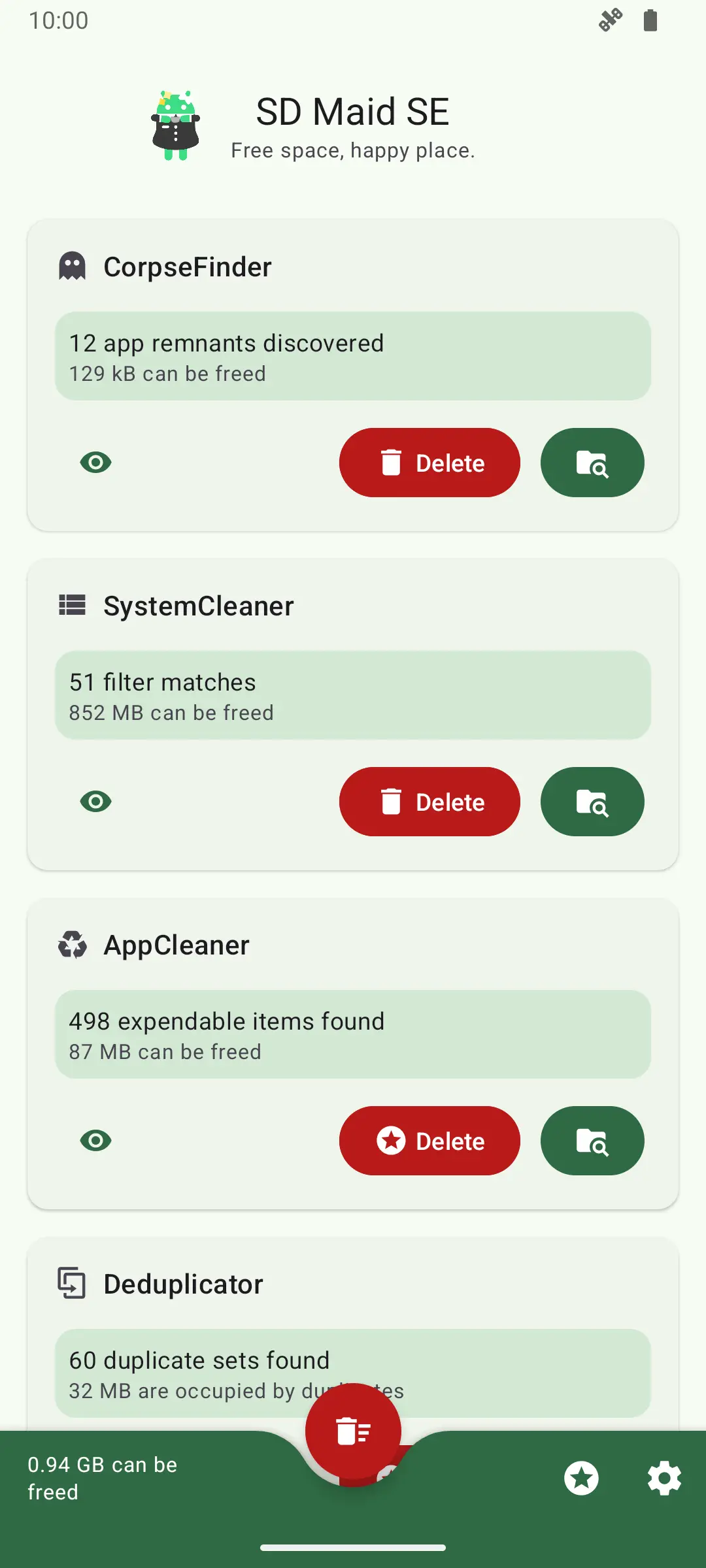
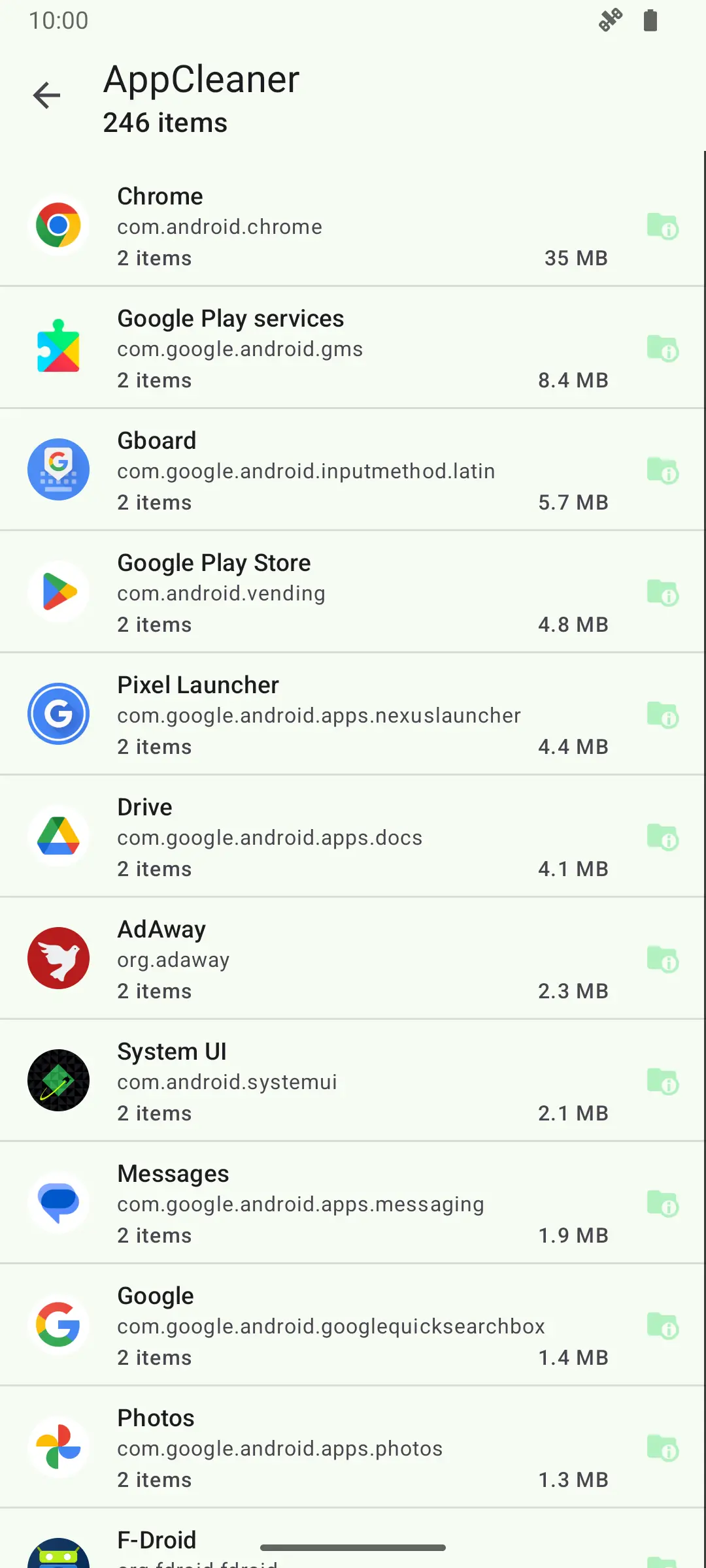
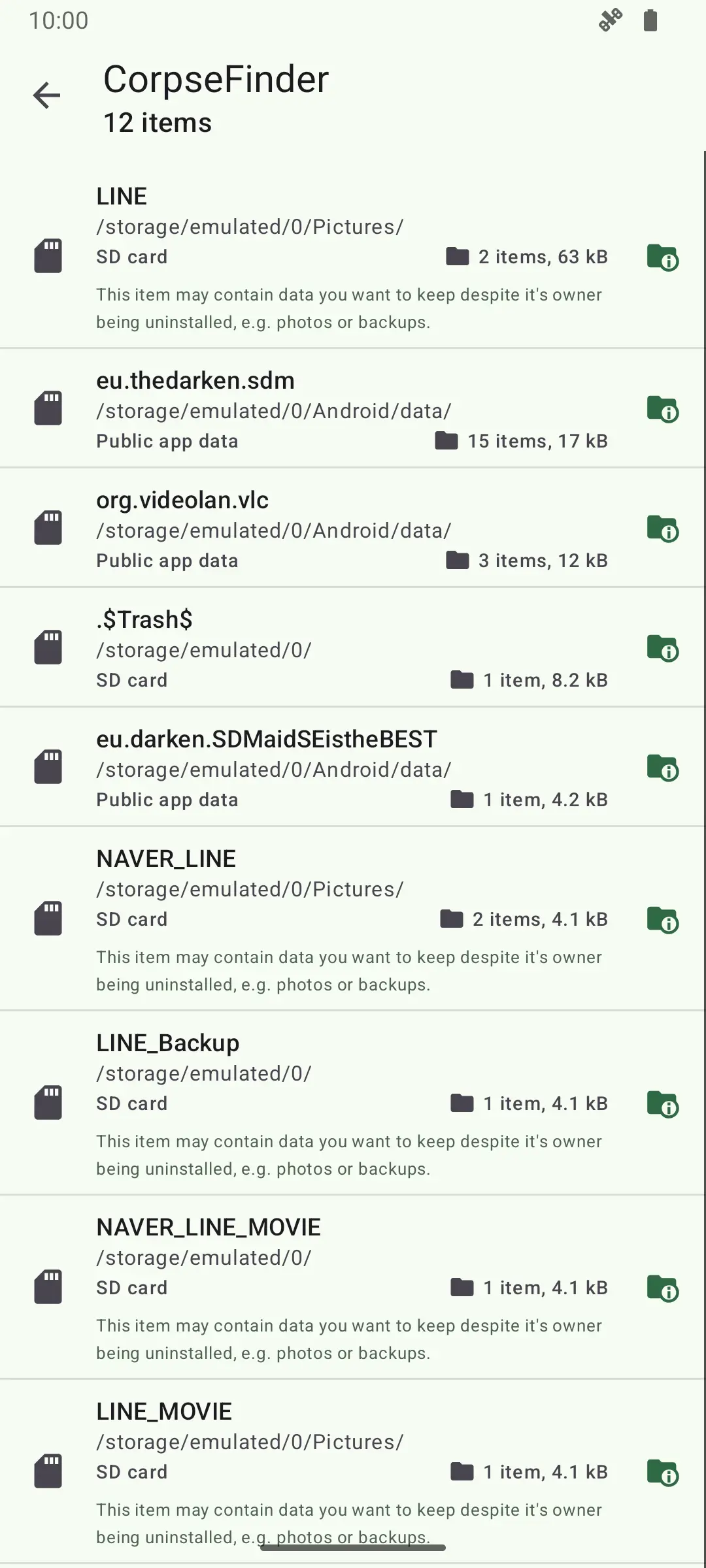
Deletes app leftovers and expendable app files; one-tap duplicate deletion is in the paid tier
Developer darken · Rating 4.6 stars from 9,554 ratings · Install band 1,000,000+ · Free to install, with in-app purchases $3.99 to $7.99 per item · Play listing updated 29 June 2026, version 1.7.5-rc0 · Requires Android 8.0 or newer (Google Play listing, read 21 August 2026) · Contains ads: No · checked 21 August 2026
Google Play listing · 4.6 (9,554) · read 7 September 2026
SD Maid 2/SE is the entry that deletes, and the reach it asks for is large. Its Play listing, read on 7 September 2026, gives 4.6 stars from 9,554 ratings, a free install with in-app purchases $3.99 to $7.99 per item and no Contains ads label. Its F-Droid entry lists twenty permissions for the build it suggests, among them all-files access, WRITE_SECURE_SETTINGS and a Shizuku permission. That is a serious ask for a storage tool, and it is the decision, not the rating. The same entry carries what the Play listing does not: version 2.0.3-rc0, added 21 August 2026, licence GPL-3.0-only, built and signed by the original developer, and one Anti-Feature flag, Non-Free Assets (F-Droid entry, read 21 August 2026).
Read this first. The one thing a cleaner is imagined to do is the one thing Android does not let a third party app do by itself. Google's own permission reference, read on 21 August 2026, defines CLEAR_APP_CACHE as: Allows an application to clear the caches of all installed applications on the device.
and gives its protection level as signature|privileged, which an app installed from a store does not hold. That permission is on this app's F-Droid list, and a manifest entry is a request, not a grant. The same reference marks WRITE_SECURE_SETTINGS, also on that list, Not for use by third-party applications.
(Google's Android permission reference, read 21 August 2026). That reference settles what the permission is and nothing else: it does not mention Shizuku once, and it says nothing about what an accessibility service is worth giving up, so the two routes around it carry their own sources here. One is the optional accessibility service the developer describes on its F-Droid entry, and Google's AccessibilityService reference, read on 21 August 2026, says of such a service: A service can specify in its declaration that it can retrieve window content which is represented as a tree of AccessibilityWindowInfo and AccessibilityNodeInfo objects.
The other is Shizuku, whose own documentation, read on 21 August 2026, describes a way for an ordinary app to use system APIs directly with adb/root privileges
. Reading the content of every window, or running at the privilege of the ADB shell, reaches further than clearing a cache. That last comparison is ours, drawn from those two documents, not a finding of Google's.
The developer says as much on its F-Droid entry, read on 21 August 2026, word for word: Using the AccessibilityService API, this app can click buttons for you to perform operations on multiple apps, e.g. deleting caches.
The same description adds, in its own words, This app is ad-free. Some features require a paid upgrade.
and states that the app does not use that API to collect information. Those are the project speaking about its own work, not findings of ours, and the Play listing set beside them carried no Contains ads label on the same date and prices its in-app purchases at $3.99 to $7.99 per item. Skip it if you will not grant all-files access, because its own catalogue list puts that permission on every build it offers. Choose SD Maid 2/SE over disky if you want something that acts on what it finds, because nothing read for this page describes the other entry deleting anything at all.
Deduplicator: Require Pro for one-tap duplicate deletion(the project's own releases page, read 21 August 2026). Nothing read for this page sets out the full split between the free and the paid tier, so the safe reading is that the free tier covers less than the tool list does.
Nothing: no source read for this page describes it deleting anything
No rating, review count, install count, price or Contains ads label is published for any app in this catalogue, and there is no Data Safety section · No Google Play listing: play.google.com returned a 404 for its package on 21 August 2026 · Permissions listed for the build it suggests, identical on all three it offers: ten entries, and the two that decide anything are MANAGE_EXTERNAL_STORAGE, which users meet as All files access, and PACKAGE_USAGE_STATS · Version 2.2.0, added to F-Droid on 2 June 2026 · Licence GNU General Public License v3.0 only, SPDX id GPL-3.0-only · Author Felix Nüsse · Summary published on F-Droid: A filesystem analyzer that can show you the usage of your storage! · Requires Android 11 or newer · Built and signed by the original developer, with F-Droid's guarantee that the build corresponds to the published source · The rest of that permissions list: view network connections, run foreground service and the dataSync foreground service type, show notifications, query all packages, run at startup, prevent the phone from sleeping, and one the app defines for itself · There is no CLEAR_APP_CACHE on that list, no request delete packages and no modify or delete the contents of your shared storage · Its entry carries no Anti-Feature flag; those flags record what F-Droid has flagged, so an absent one is not a finding that the app is clean · F-Droid entry, read 21 August 2026
F-Droid entry · no rating or install count is published there to quote · read 21 August 2026
disky is the entry that measures rather than removes, and the blunt part is that it asks for the storage reach of something that removes. Its ten listed permissions include MANAGE_EXTERNAL_STORAGE, which Google defines as Allows an application a broad access to external storage in scoped storage.
and marks as intended for the few apps that manage files on a user's behalf. That is the same all-files access the other entry here asks for. The other permission that decides anything, PACKAGE_USAGE_STATS, is on its manifest but is not a demand: the project's own release note for 2.1.0, published 19 April 2026, says Disky does not force you to grant app-usage statistic-permissions anymore, though i really recommend granting it.
The lower case there is the developer's (the project's own releases page, read 21 August 2026). A manifest entry is a request rather than a grant on this row too, and this page owes that reading to both entries. What its list does not carry is anything about caches or packages, and no source read for this page describes it deleting anything. Neither catalogue read for this page rates it, prices it or labels it for advertising: Google Play returned a 404 for its package on 3 September 2026, and F-Droid publishes none of those fields for any app.
Read this first. Its own releases page, read on 21 August 2026, is the reason this section exists in the shape it does. The project has published 11 releases, and between 1.1.0 on 16 May 2024 and 1.3.1 on 11 February 2026 it published none at all: a gap of more than twenty months. Five of its releases are dated inside 2026, so the record read today is of a project that stopped and started again, and that is a fact about the release feed rather than about anyone's intentions. The newest note in that feed is not a changelog at all: 2.2.0, published 31 May 2026 and the build F-Droid suggests today, carries one line of text, This app is under threat.
, and a link to a campaign site that this page has not read and does not summarise. What the notice means for the app is not something the feed says, and guessing at it here would be worth less than pointing at it (the project's own releases page, read 21 August 2026).
Its F-Droid entry, read on 21 August 2026, summarises it as a filesystem analyzer that can show you the usage of your storage, and the description the developer published under that summary says, word for word: disky can analyze your device and show your data split by directory. Apps are also included, so you get the full picture of what uses your storage.
That is the project describing its own work. The licence separates the two entries not at all: it is the same GPL-3.0-only the other one carries, so on this page it decides nothing. Skip it if you expect it to act on what it finds, because nothing on its entry or in its own description says it does. Choose disky over SD Maid 2/SE if you only want to know where the space went, because its catalogue list stops at reading storage where the other adds cache, package and secure-settings permissions on top of the same all-files access.
Before either app is compared, one thing has to be said plainly, because it bounds what any app in this category can do and neither catalogue mentions it.
Google's own permission reference, read on 21 August 2026, lists CLEAR_APP_CACHE, the permission whose description is Allows an application to clear the caches of all installed applications on the device.
, at protection level signature|privileged. Those two words mean it is granted to apps signed with the platform key or shipped in the privileged system partition, and not to an app a reader installs from a store. So the headline promise of the whole category, one tap that empties every app's cache, is not something a downloaded app performs on its own authority. There are two workarounds, both visible in the same permission lists this page quotes, and each carries its own source rather than borrowing this one, which mentions neither. The first is an accessibility service: the SD Maid 2/SE developer's own description says the app uses one to click buttons for you, and Google's AccessibilityService reference, read on 21 August 2026, says of such a service, A service can specify in its declaration that it can retrieve window content which is represented as a tree of AccessibilityWindowInfo and AccessibilityNodeInfo objects.
The second is Shizuku, whose own documentation, read on 21 August 2026, describes a way for an ordinary app to use system APIs directly with adb/root privileges
. Reading the content of every window, or running at the privilege of the ADB shell, reaches further than clearing a cache. That last comparison is ours, drawn from the two documents linked in this paragraph, and it is the real decision on this page.
The other permission both entries ask for is MANAGE_EXTERNAL_STORAGE, which the same reference describes as Allows an application a broad access to external storage in scoped storage.
and says is Intended to be used by few apps that need to manage files on behalf of the users.
It is the one users meet as All files access. Both entries here ask for it, the analyzer as much as the cleaner, and that is worth knowing before either is installed.
The catalogues answer different questions, and the difference belongs to them rather than to the apps. Google Play publishes a rating and a rating count, an install band, a price, an in-app purchase range, a Contains ads label where the app carries advertising, and a Data Safety section. F-Droid publishes none of those, for any app it carries. What its entries do carry, read on 21 August 2026, is the developer's summary and description, the author, the licence, the three most recent versions with the date each was added, the minimum Android version, the permissions each build requests, the download with its signature and build log, project links, and any Anti-Feature flag. That permissions list is the reason this page leans on F-Droid rather than on Play: the Google Play listing read for this page prints no permissions list. What Google Play publishes on other surfaces is not something this page checked, and the claim here is only about the listing that was read.
One kind of flag does answer a question a store label would answer, though not the way a label does. Anti-Features are F-Droid's own warning flags, and it publishes the list it uses: one entry on that list is Ads, which it defines as the flag applied to an app that contains advertising. Neither entry here carries that flag. The one flag on this page is Non-Free Assets on SD Maid 2/SE, and the reason F-Droid prints for it on that app's F-Droid entry, read on 21 August 2026, is: The icons, logos, mascots, marketing materials and assets are not licensed under GPL v3.
The same list defines that flag as non-libre media in things that are not code, so it is about the licence on artwork, not about tracking or advertising, and it is easy to misread as a privacy warning. On the other entry, read the same day, there is no flag at all, which is the absence of a warning rather than a finding that the app is clean.
The dates are three measurements, not one, and this page prints all three separately. Google Play prints when a listing was last updated. F-Droid prints the date on which one version entered its repository. A project's own releases page prints when the project published something. None of the first two is a release date, and reading them as one is how a freshness column inverts. SD Maid 2/SE shows all three at once, read on 21 August 2026: its own releases page dates 2.0.3-rc0 to 18 August 2026, F-Droid dates that same build 21 August 2026 because that is when the build entered its repository, and the Play listing reports 1.7.5-rc0 from a listing update on 29 June 2026. One build, two different dates, and a third catalogue still showing an older version. One freshness rule applies to both entries, stated once: a record that has not been updated for more than eighteen months is called out on this site as stale, and neither entry is anywhere near that line today.
It comes down to what you want done, and to how much of the phone you are willing to hand over to have it done.
Take SD Maid 2/SE if you want something that acts on what it finds. Its own description names the tools that do the deleting, its Play listing answers the price, ads label, rating and data handling questions above, each dated in its section, and its F-Droid entry adds a licence, a current version and the permissions list this page leans on. Accept in exchange the size of the grant: all-files access on every build, and, for another app's cache, an accessibility service that can be declared to read the content of the windows on screen, or Shizuku, which its own documentation describes as running an ordinary app's calls at adb or root privilege. Accept too that its own release note of 8 June 2026 puts one-tap duplicate deletion behind the paid tier, so part of what the table credits it with is not in the free install. Accept too that a Data Safety section is a declaration made to Google by the developer rather than a measurement, and that the suggested build in both catalogues is a release candidate.
Take disky if the question is only where the space went. It is a filesystem analyzer by its own summary, its catalogue list stops well short of the other's, and its source is linked from its entry. Accept in exchange that it still asks for all-files access, that neither catalogue read for this page rates it, prices it or labels it for advertising, and that its own releases page shows a gap of more than twenty months in the middle of its history.
Take neither, for the one job the category is named after. Clearing every app's cache in one tap is not a thing a downloaded app is permitted to do by itself: the permission for it is reserved to apps signed with the platform key or shipped in the system partition. That is not a criticism of either app: it is the shape of the platform, and it is why both of these are file tools rather than the one tap button the category advertises.
This page carries two entries where it once carried more. An entry here needs a first party catalogue record that can be re-read on the day of writing, with the date printed beside every figure. These two have one. Every entry that went is named in the changelog at the foot of this page, with the reason it went, and two entries is a thin year for a category this size. Saying so is more useful than filling the gap. For the standing shortlist, see the cleaner apps roundup.
Not on its own. Google's Android permission reference lists CLEAR_APP_CACHE, the permission for clearing the caches of all installed apps, at protection level signature|privileged, which means it goes to apps signed with the platform key or shipped in the privileged system partition, not to an app you download. An app can declare it and still not be granted it. The routes around that are an accessibility service that taps through the system dialogs for you, or Shizuku, whose own documentation describes a way for an ordinary app to use system APIs directly with adb or root privileges. Google's own AccessibilityService reference says such a service can be declared so that it retrieves the content of the windows on screen. Reading every window, or running at the privilege of the ADB shell, reaches further than clearing a cache, and that last comparison is ours rather than Google's. The permission for that job sits with the system rather than with anything you install. Checked 21 August 2026.
Its F-Droid entry lists twenty permissions for the build it suggests, 2.0.3-rc0, read on 21 August 2026. Among them are all-files access, usage access, request delete packages, modify or delete the contents of your shared storage, have full network access, CLEAR_APP_CACHE, WRITE_SECURE_SETTINGS and a Shizuku permission. A permissions list records what a build may reach, not what it sends or what the system actually grants it. The Google Play listing read for this page prints no permissions list, so this comes from F-Droid. Checked 21 August 2026.
Nothing read for this page says it does. Its own summary on F-Droid calls it a filesystem analyzer that can show you the usage of your storage, and the description under it says it shows the data on a device split by directory, apps included. Its permissions list carries ten entries with no cache permission and no request delete packages on it. It does ask for all-files access, which is the broadest storage permission Android has, so the reach is there even where a described use is not. Checked 21 August 2026.
SD Maid 2/SE. Its Google Play listing gives 4.2 stars from 8,883 ratings and an install band of 1,000,000+, read on 21 August 2026. disky is catalogued on F-Droid, which publishes no rating and no review count for anything it lists, and Google Play returned a 404 for its package on the same date. A missing rating there is a property of the catalogue, not a low score. Checked 21 August 2026.
It is free to install, and its Play listing prices its in-app purchases at $3.99 to $7.99 per item, read on 21 August 2026. That listing carried no Contains ads label on the same date, and its Data Safety section declares no data shared with third parties and no data collected, which is a declaration made to Google by the developer rather than an audit result. The description on its F-Droid entry states that the app is ad-free and that some features require a paid upgrade, and that is the project writing about its own work. The project's own release note for 1.7.4-rc0, dated 8 June 2026, records one-tap duplicate deletion being put behind that upgrade, so at least one of the things the comparison table credits the app with is not in the free install. Nothing read for this page sets out the full split between the free and the paid tier. Checked 21 August 2026.
Because the three dates measure three different things. On 21 August 2026 the Play listing reported 1.7.5-rc0 from a listing update on 29 June 2026, F-Droid suggested 2.0.3-rc0 added on 21 August 2026, and the project's own releases page carried 2.0.3-rc0, published on 18 August 2026. A Play date is when a listing changed, an F-Droid date is when a build entered that repository, and only the third is a release. Reading any of them as the other is how a freshness claim inverts. Checked 21 August 2026.
It is one of F-Droid's own Anti-Feature warning flags, listed and defined in the Anti-Features documentation F-Droid publishes, and the reason the entry gives for this app is that the icons, logos, mascots, marketing materials and assets are not licensed under GPL v3. It is a statement about the licence on the artwork. It is not a finding about tracking, advertising or data handling, and it is easy to misread as one. That same list keeps a separate flag for advertising, and neither entry on this page carries it. Checked 21 August 2026.
No. A licence says what may be done with the code, not what a build does on a phone, and both entries here carry the same one. One of the two has a data handling declaration to read: the Play listing for SD Maid 2/SE says no data shared with third parties and no data collected, which is the developer's word to Google rather than an audit finding. F-Droid publishes no data safety section, so for the other entry there is no declaration at all, which is not the same as a clean one. What both entries do carry is a permissions list, and that records what a build may reach. Checked 21 August 2026.
Checked 21 August 2026: every figure re-read at its own source on 21 August 2026. Both Play figures had moved since the 16 August 2026 pass and both are corrected: the rating from 4.1 to 4.2, and the rating count from 8,843 to 8,883. The install band, the in-app purchase range, the absence of a Contains ads label and the Data Safety lines are unchanged, and now carry today's date. The F-Droid entry for SD Maid 2/SE moved while this pass was being written: it was read once earlier in the day, when the build it suggested was 2.0.2-rc0 added on 10 August 2026, and again at the end of it, by which time F-Droid had added 2.0.3-rc0 and made that the suggested build. Every figure this page takes from that entry, the version, the date it was added and the twenty permissions it lists, was re-derived from the later read rather than carried over, and the permission list is now counted out of that copy by the build itself instead of transcribed.
Added: the column this page should always have had. The table compared price, the ads label and the rating, and none of those three is the decision a reader of a cleaner article makes. It now leads on what each app deletes and what permission it asks for, both read from the permissions list and the description each app's own catalogue publishes. Added with it: a section sourced to Google's own permission reference, read on 21 August 2026, which puts CLEAR_APP_CACHE at protection level signature|privileged and so settles what a downloaded app in this category can and cannot do by itself. Nothing on the page said that before, and it bounds every claim on it.
Both cells in that column were then corrected against the release feeds this page already reads, because a column a page leans on is worth reading twice. The deletes cell credited SD Maid 2/SE with duplicate files and said nothing about price, while the project's own release note for 1.7.4-rc0, dated 8 June 2026, records one-tap duplicate deletion moving behind the paid tier: the cell, the section, the FAQ and the choose section now say so, and the capsule now claims only the best free install rather than the best free app. The permission cell reported disky's usage access as a flat ask, while its own release note for 2.1.0, published 19 April 2026, says it no longer forces that grant: the same rule this page applies to a manifest entry on one row now runs on the other. The deletes cell also no longer repeats the verdict pill word for word; it carries the developer's own names for the tools instead.
The two routes around CLEAR_APP_CACHE now carry their own sources. The page used to close that paragraph with a citation to Google's permission reference, which mentions neither an accessibility service's reach nor Shizuku at all, so our judgement wore Google's name. Each route is now cited where it is documented: Google's AccessibilityService reference and Shizuku's own documentation, both read on 21 August 2026 and both linked, and the comparison between a grant and a deletion is now labelled as ours. Two claims of absence about Google Play were narrowed to the listing this page actually read. The disky section gained the one thing the newest release note in its feed says, which is a notice rather than a changelog.
A correction to this page's own last correction. On 16 August 2026 this page retracted its claim that disky came back from two dormant years, because that claim rested on a releases feed the pass had not re-read. The feed was read today, from the repository the app's own F-Droid entry links as its source, and the underlying fact holds: the project published nothing between 1.1.0 and 1.3.1, a gap of more than twenty months. What stays withdrawn is the wording, which overstated the gap as two years and read intent into a release feed. The body now states the measurement and names what measured it. The same applies to the release channel claim withdrawn that day, that the 2.0 work had landed but only in beta: the feed read today shows the newest release the project has published itself is 2.0.3-rc0, dated 18 August 2026, and it is not flagged as a prerelease, so the body states that instead. The withdrawal of APKMirror as a source stands: it is a mirror rather than a first party record.
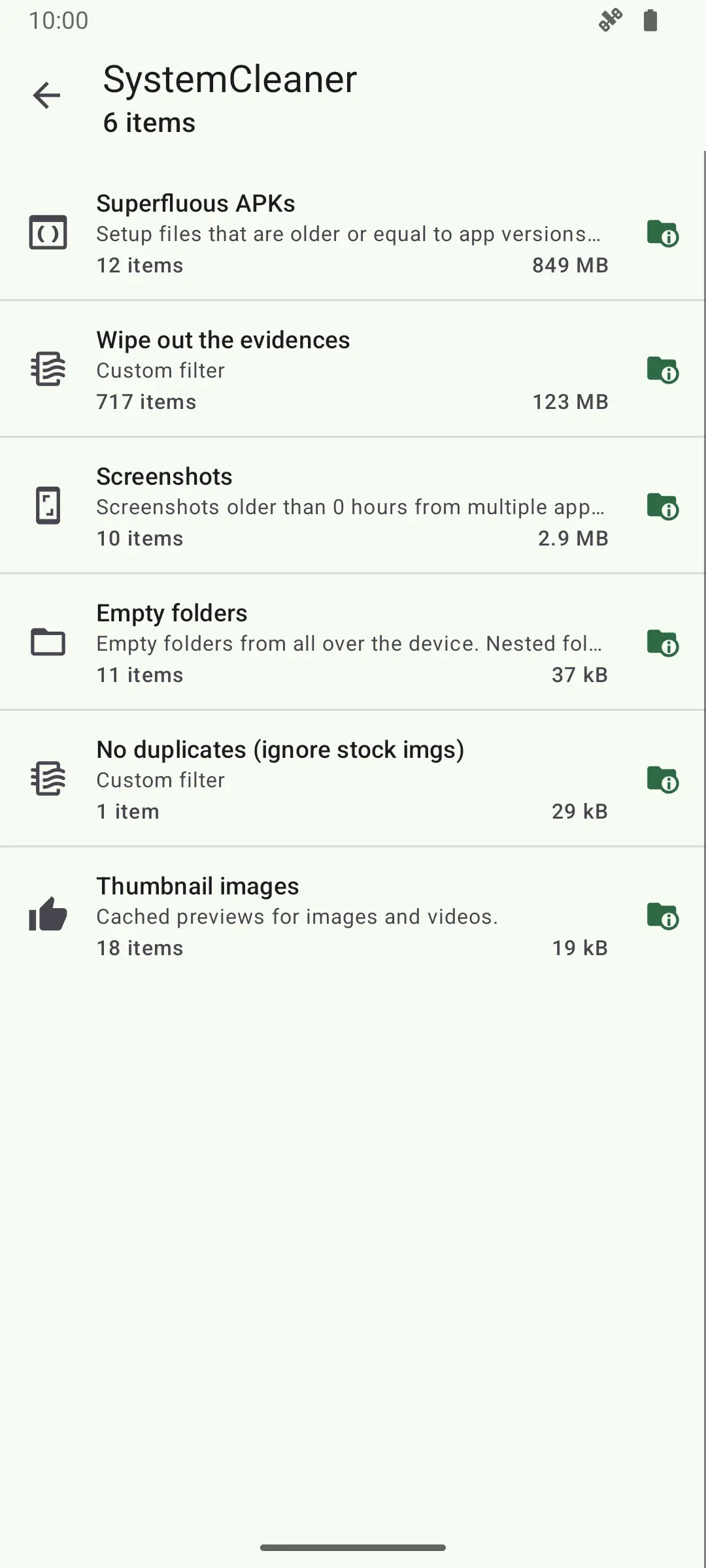
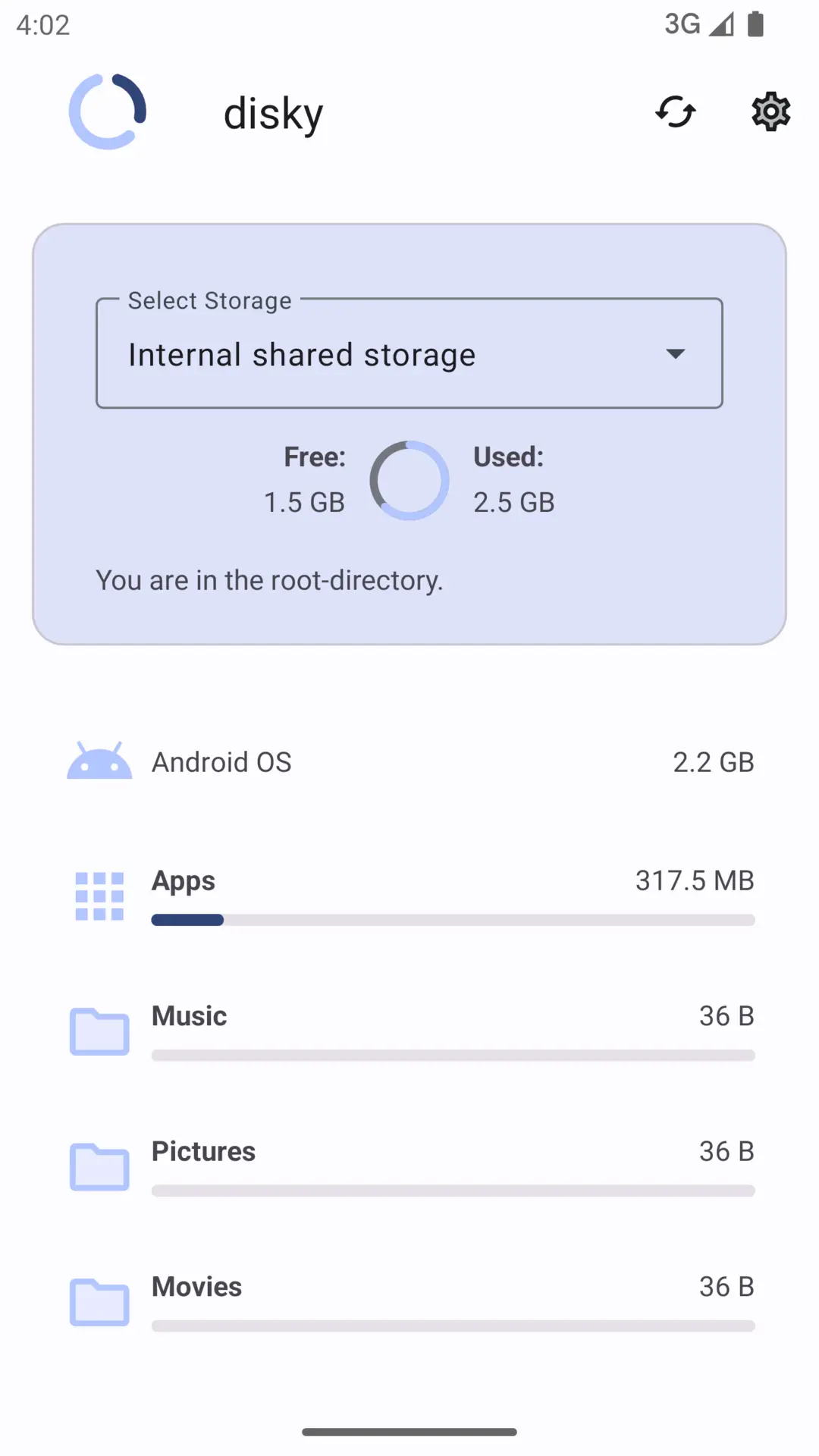
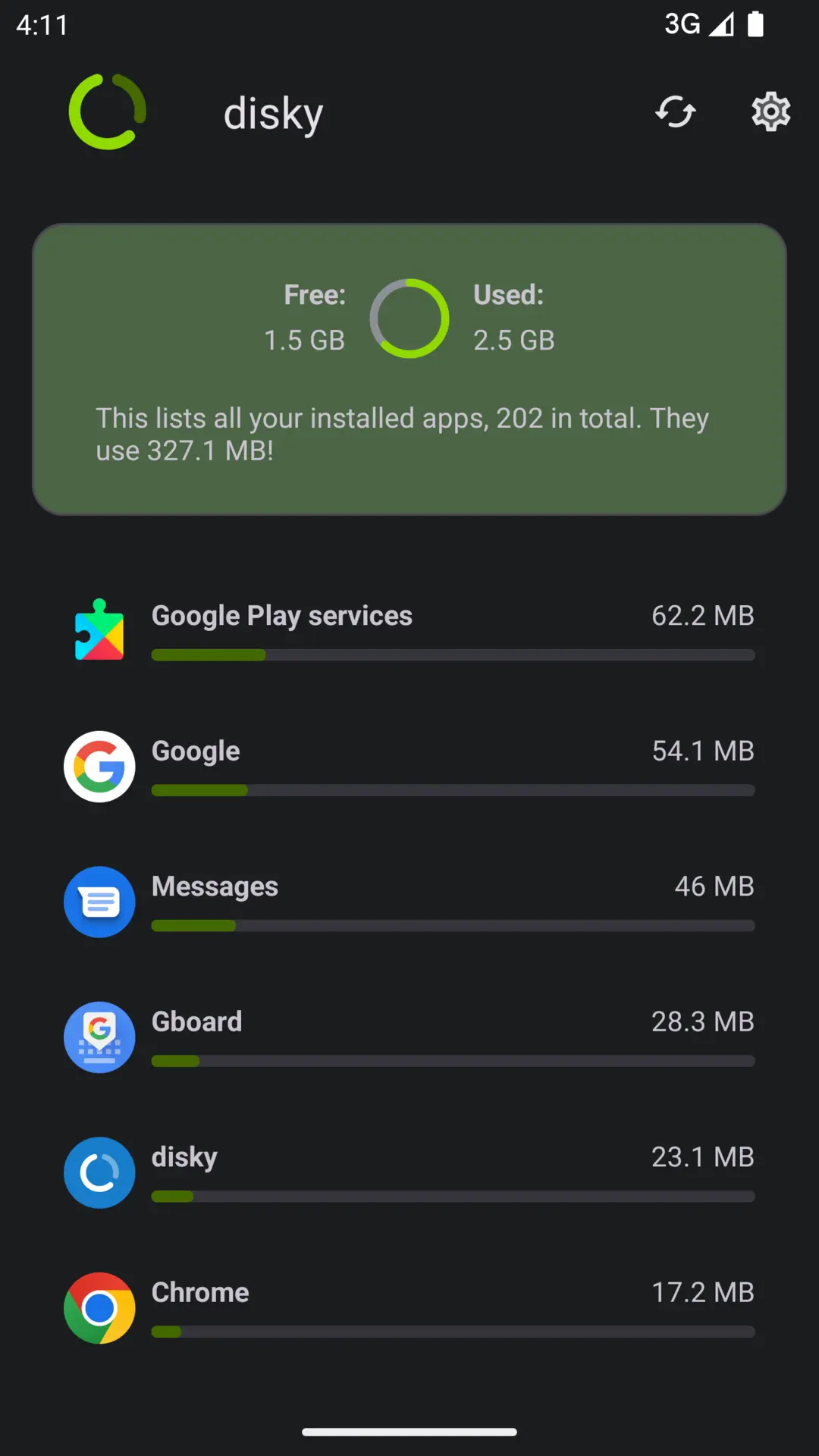
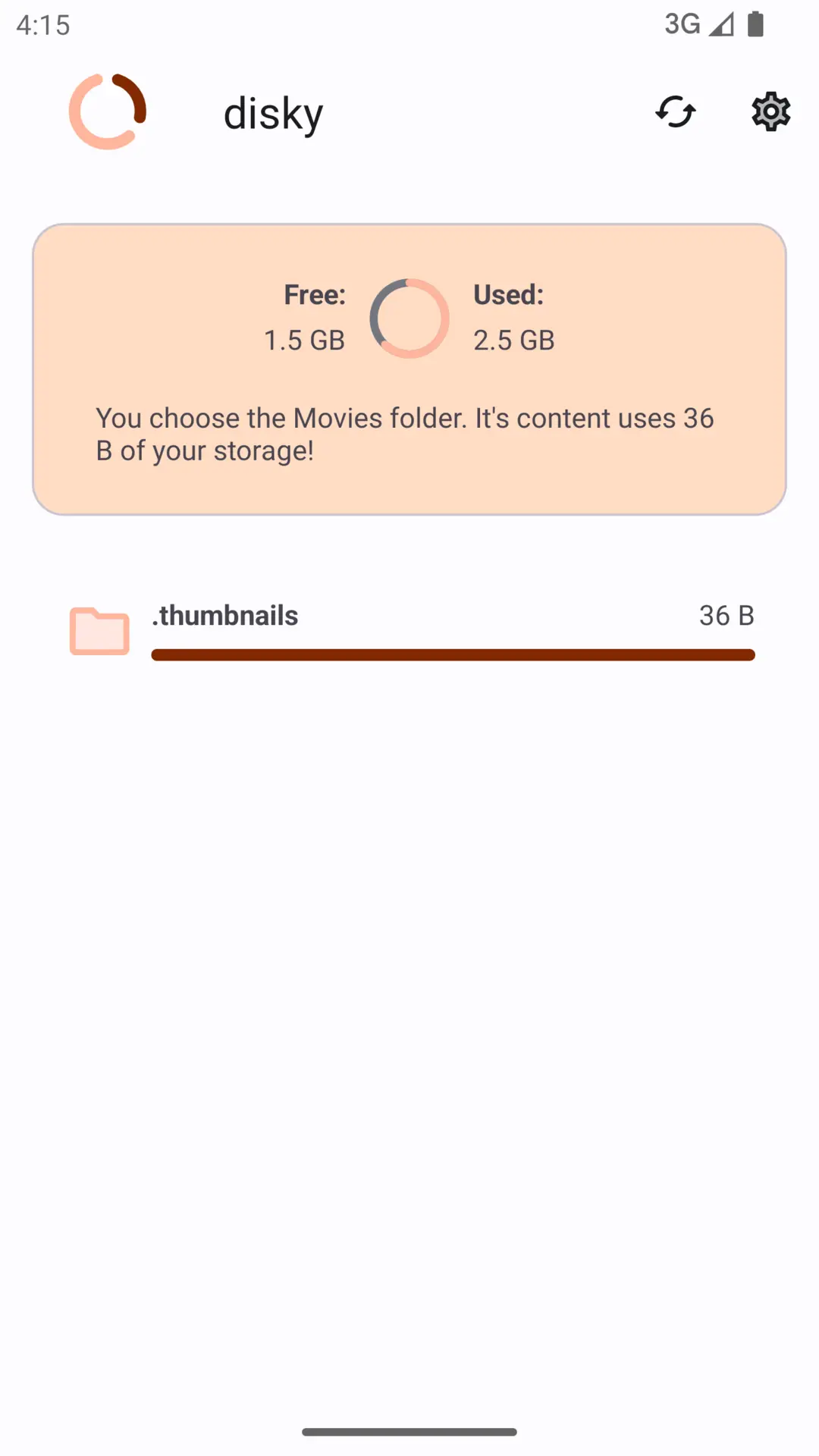
One screenshot caption was wrong and is corrected. The second disky image was captioned as a ring chart breaking down which installed apps use the most space. The screen in that file is the installed app list in the app's dark theme, one bar for each app, under the same free and used ring the first image already shows. Both copies of that caption, the thumbnail and the lightbox, now describe the screen the file actually contains. Every image on this page was opened and read before this pass; the other six captions were accurate and are untouched. All seven image files, both galleries and every figure element are carried through unchanged apart from those two copies of that one caption, which are the only bytes inside a figure that this pass altered, and the build refuses to write if the image set, the figure count or the gallery count changes in either direction.
Also this pass: the SD Maid 2/SE section now carries the permissions its F-Droid entry lists for the build it suggests, twenty entries, and disky's carries its ten. Both entries ask for all-files access, which is stated on both rather than only on the one that deletes. The title and the search snippet were rewritten to name the permission question rather than the catalogue comparison. Nothing on this page claims anyone installed or ran either app, and the dated How we verify box, now naming six sources rather than two, remains the only framing for how any of it was obtained.
Checked 16 August 2026: this page was rebuilt from what two catalogues publish: the Google Play listing for SD Maid 2/SE, and the F-Droid entries for SD Maid 2/SE and disky. The version read that day carried no Google Play link at all, and its only catalogue links were the two F-Droid listing links inside its screenshot captions. Not one figure was carried over from it: it printed no rating, no rating count, no install band and no ads label for any app, and no price beyond the word free with no date beside it; where it said there are no ads for SD Maid 2/SE it named neither a source nor a date.
Entries removed that day: CleanSweep, which had a section of its own, together with the seven names in the section the page headed What we checked and found no news on: Files by Google, Cache Cleaner, WhatsApp Cleaner, Norton Cleaner, CCleaner, AVG and Avast. That section printed a date for three of the seven and none at all for the other four, and it named no catalogue record for any of them. None was cut for being dead: each was cut because that pass had no first party catalogue record to re-read it against. No block was deleted; every section whose subject left now carries copy sourced from a catalogue. The 1.0.0 first stable date went with the entry that carried it.
 Offline Weather Apps on Android: Stay Informed Without InternetTools & Utilities