Updated September 2026 · both apps now carry their own dated listing figures, and the ads label on one of them is stated
No printer needed: both routes here sign a PDF on the phone in a couple of minutes. What matters afterwards is flattening, and knowing when a drawn signature is not the right instrument at all.
Before you tap anything, it helps to know there are two different things people call a signature, and they are not the same.
The first is an electronic signature: a picture of your handwriting placed on the page, or a typed name styled to look signed. This is what almost every lease, consent form, and ordinary business agreement asks for. In the United States it is legally binding under the ESIGN Act and UETA, and it is what this guide mostly covers.
The second is a cryptographic digital signature. That one uses a certificate issued by a certificate authority and public-key encryption to bind your identity to the file and prove it has not been altered since you signed. It is a specific, narrower thing. A drawn signature is fine for daily documents, but it is not a cryptographic digital signature, and a few institutions (some courts, some government filings, some regulated finance and healthcare paperwork) will only accept the certificate kind. If the sender mentions a "qualified" or "certificate-based" signature, skip ahead to the section on that. For everything else, read on.
Signing without an upsell
4.2 stars from 475,181 reviews · 10,000,000+ installs · free to install · in-app purchases $2.99 to $109.99 per item · by Xodo Technologies · Contains ads: No · checked 3 September 2026
Google Play listing · 4.2 (475,181) · read 3 September 2026
Xodo is the calmer of the two: signing is free, the app does not push a subscription at every step, and its listing carries no Contains ads label. You can draw with a finger or import a photograph of a real signature and reuse it. The blunt con: a much smaller track record than Acrobat at 475,181 reviews, and the paid tier starts higher, at $2.99 per item.
Xodo describes the job on its own Play listing: "Fill forms, sign and manage documents easily."
Xodo (full name "PDF Reader & Editor: Xodo" on Google Play) is a free PDF app that handles signing well and does not nag you much. It was last updated in June 2026, so the steps below match the current version.
After you install it and open the PDF:
Xodo also has a built-in scanner, which is useful if part of your task is turning a paper page into a PDF first. If you are weighing it against other options, it appears on our roundup of the best PDF editor apps for Android, and it sits in the wider ultimate list of free Android PDF editors if you want to compare the free tiers side by side.
The app senders expect
4.5 stars from 7,929,987 reviews · 500,000,000+ installs · free to install · in-app purchases $0.99 to $299.99 per item · by Adobe · Contains ads: Yes · checked 3 September 2026
Google Play listing · 4.5 (7,929,987) · read 3 September 2026
Acrobat Reader is the one most senders assume you have, and its Fill and Sign tool signs a flat scan as happily as a form with real fields. It is free to install, and its own listing carries the Contains ads label with in-app purchases from $0.99 to $299.99 per item. The blunt con: the paid tier is pushed hard inside the app, and signatures placed as annotations still need flattening before you send.
Adobe Acrobat Reader is the other dependable free choice, and a lot of senders expect it because it is the app that made the format. The signing tool you want is called Fill and Sign, and it works without a paid subscription and without an internet connection.
One thing to know about Acrobat: signatures and initials become permanent once you save, and the file flattens on save, so it cannot be unsigned afterward. That is usually what you want, but it means you should fill in every field before that final save. Acrobat is also covered on our list of the best PDF reader apps for Android if reading and annotating are a bigger part of your routine than signing.
A signature on a blank form is not much use. Most contracts and applications have name, date, address, and checkbox fields that need filling too. Both apps handle this through the same Fill and Sign mode you used for the signature.
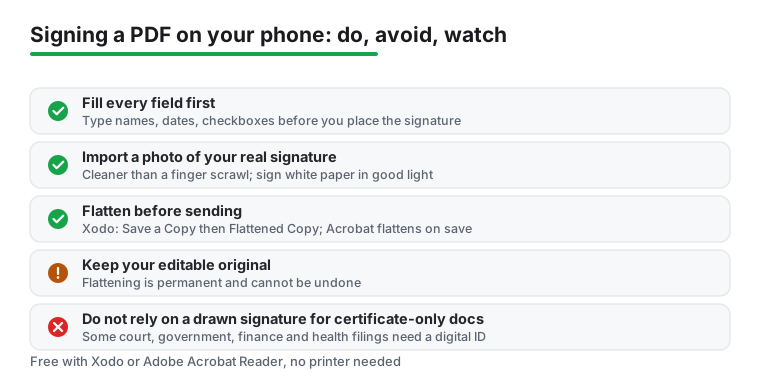
If the PDF was built as a real form, the fields are interactive and you just tap into them. If it is a flat scan with printed lines, you place text boxes manually where the answers go. Type the field, drag it onto the line, and shrink the font so it sits cleanly. Do this for every field before you sign, because in Acrobat the save step locks everything at once. Tidy form work like this is part of a calmer phone productivity setup, and it saves you re-sending a half-filled document.
Take thirty seconds to proofread once everything is placed. A misspelled name on a signed contract is annoying to fix after the file is flattened.
Here is the step people skip, and it matters. When you place a signature as an annotation, it can technically be dragged, resized, or deleted by anyone who opens the file in an editor. Flattening fixes that. Flattening merges every annotation, form field, and signature into the page itself, like ink soaking into paper. The content stays visible but is no longer editable or movable.
In Acrobat, this happens automatically: the file flattens when you save, so you do not need a separate step. In Xodo, do it yourself. Tap Save a Copy, then choose Flattened Copy from the menu. Send that flattened copy, not the original working file.
One caution: flattening is permanent. You cannot un-flatten a PDF to get the editable fields back. So keep your unflattened version if you might need to change something, and only flatten the copy you are about to send.
Once the file is signed and flattened, share it straight from the app. Use the share icon and send through email or your messaging app, or save it to Google Drive and share a link if the file is large.
Two small habits help. Send a PDF, never a screenshot of the screen, because the recipient often needs to file the actual document. And name the file something clear like "lease-signed-yourname.pdf" so the person on the other end does not have to guess.
Most of the time the routes above are all you need. But be honest with yourself about the document. A drawn or photographed e-signature is valid for everyday agreements, yet it carries less weight in a dispute than a certificate-based digital signature, which provides cryptographic proof of who signed and that nothing changed afterward.
Some institutions require that stronger kind. Certain court filings, government submissions, and regulated finance or healthcare paperwork ask for a digital signature backed by a certificate from a certificate authority, sometimes a "qualified" signature in Europe. You cannot produce that with the free Fill and Sign tools; it needs a digital ID issued to you, set up through a service such as Adobe Acrobat Sign or a national e-ID scheme. If the sender uses the words "certificate," "digital ID," or "qualified electronic signature," ask them which provider they expect before you sign anything, so your signature is actually accepted.
For everyday agreements in most places, yes: an electronic signature is widely accepted. High value or regulated documents may require a digital signature backed by a certificate, which is a different instrument. When in doubt, ask the party that sent the file what they will accept. Checked 3 September 2026.
No. Signing is in the free tier of both. Xodo lists in-app purchases from $2.99 to $109.99 per item and Acrobat Reader from $0.99 to $299.99, read 3 September 2026, and those buy editing and conversion rather than the signature itself. Checked 3 September 2026.
Flatten the document before sending. Flattening merges the signature into the page so it is no longer a draggable annotation. Both apps offer it as a save or share option. Checked 3 September 2026.
Yes, and it usually looks better. Sign a white sheet in dark ink, photograph it in even light, and import the image as your signature. Both apps keep it for reuse afterwards. Checked 3 September 2026.
An electronic signature is a picture of your handwriting placed on the page. A digital signature is a cryptographic certificate that binds the signer to the file and shows tampering afterwards. The second is what regulated documents ask for. Checked 3 September 2026.
Through a browser service, yes, with the trade that the document is uploaded to someone else's server. For a lease or a contract, signing on the phone in one of these apps keeps the file on the device. Checked 3 September 2026.
Checked 3 September 2026: the guide named Xodo and Acrobat Reader, linked neither and carried no rating, no install band, no price and no dated line. Both now have a fact line read from their own listing, a store link, a decision table row and three pros and three cons. The correction that matters: Acrobat Reader is free to install but its own listing carries the Contains ads label and sells in-app purchases to $299.99 per item, while Xodo, the smaller app at 475,181 reviews, carries no ads label at all.
 8 Free Android PDF Editors · Where Each One Stops Being FreeProductivity
 Best PDF Reader Apps for AndroidBooks, News & Education