Several jobs, rarely one app
It helps to stop treating "entertainment" as a single thing. On a phone it is really a handful of different jobs, and the app that is good at one is usually mediocre at the others. There is on-demand subscription streaming, the big paid catalogues of shows and films. There is free ad-supported streaming, often called FAST, which is now a mainstream tier rather than a fallback. There is live and linear TV, channels that play on a schedule. There are personal media players and home servers for files you already own. And there are games, which split into quick casual titles, bigger console-style and online releases, and cloud-gaming clients that stream a game from a server so your phone does not have to run it.
Most people end up with two or three of these, not one. To give a sense of scale on the free tier: FAST is forecast to reach about 131 million US viewers in 2026, roughly 54% of all connected-TV users, with the Roku Channel, Tubi, and Pluto TV leading the pack. That is not a niche corner anymore. Picking well starts with knowing which of these jobs you actually want a phone to do.
Streaming and watching
The split that matters is on-demand versus FAST versus live. On-demand means you choose any title in the catalogue whenever you want, which buys you control and newer content but costs a monthly fee. FAST gives you free, ad-supported channels and a rotating library; you trade choice and freshness for paying nothing. Live and linear apps put scheduled channels and sport on the phone, closer to old-fashioned TV. Whichever you lean on, the same practical checks apply: does it hold a steady picture over both Wi-Fi and mobile data, can you cap or raise the quality, does it cast to a TV, and can you download titles for a commute or flight. A huge catalogue is no use if it buffers every few minutes. For the paid catalogues see our movie streaming picks, and for channels and live see the TV streaming guide.
Players for what you already own
This job gets forgotten. If you have your own files, ripped discs, FLAC music, MKV videos, or odd formats a streaming app will not touch, you want a media player or a home server, not a streaming service. These apps play local files, handle subtitles and multiple audio tracks, and can stream from a server you run at home to the phone in your hand. A streaming app is the wrong tool here; it is built to deliver someone else's catalogue, not to open the files sitting on your own storage. If your collection is the point, look for format support and subtitle handling first.
Games
Games break down by weight. Casual and offline titles are small, run without a connection, and are easy to put down. Bigger console-style and online multiplayer games ask for more storage, often a constant connection, and sometimes an account. Cloud-gaming clients such as GeForce NOW sit apart again: they stream a demanding PC or console game from a server, so a modest phone can run something it could never install, as long as your connection is steady. Two 2026 changes are worth knowing. Google Play now offers Game Trials, a free time-limited go at the full version of select paid games before you buy, and "Buy Once Play Anywhere" pricing, where one purchase covers both the phone and PC version of a game. Before installing, check the file and install size, whether it plays offline, and whether it needs an online account. Our wider games guide goes deeper.
How to choose
The one question that saves you money and clutter is plain: what do you actually watch and play. Answer that honestly and the rest follows. A short decision aid:
- New releases or back catalogue. If you chase the latest shows and films, a paid on-demand service earns its keep. If you are happy working through older titles, free FAST channels cover a lot for nothing.
- Specific franchises or studios. Some series live on one service only. If there is a show you must have, that single fact can decide which subscription you keep.
- Heavy or light use. Light viewers usually get more from one free app than from a subscription they barely touch. Heavy viewers can justify paying.
- How you watch. A commute or flights means downloads and offline support matter. Watching at home means casting and quality settings matter more.
- Your hardware. An older phone leans toward FAST apps and cloud gaming, since both put less work on the device itself.
Cost and privacy
Entertainment apps make their money in ways that are easy to miss until the charge lands, and they ask for permissions a phone game has no business needing. Both are worth a careful look.
What you actually pay
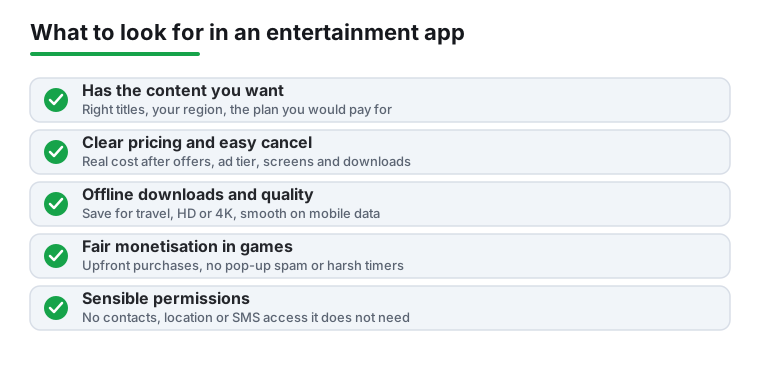
Streaming has more cost axes than a single monthly price. Watch for the gap between an ad-supported tier and an ad-free one, how many screens or profiles can watch at once, and whether downloads are capped per plan. Some apps that look like a flat subscription also hide per-title rentals or purchases inside them, so a film you expected to be included costs extra. Free trials quietly convert to paid, so set a reminder the day you start one. And do not stack overlapping catalogues; rotate through them instead, keeping one running at a time. For games, the Play listing shows the in-app purchase price range. A fair game sells convenience or cosmetics, not the basic ability to keep playing, and the 2026 Game Trials feature lets you test a paid title before you commit.
Permissions and data
Entertainment apps rarely need much. A game asking for your contacts, precise location, or SMS is a red flag, not a feature; there is almost never a real reason for it. Recent Android versions let you grant access to selected items rather than your whole media library, and Google Play now scrutinises apps that request broad photo, video, or storage access, requiring them to justify it. The practical rule is simple: prefer apps that ask for less, grant the narrowest access that still works, and treat a simple app demanding wide permissions as a reason to look elsewhere.
Common mistakes to avoid
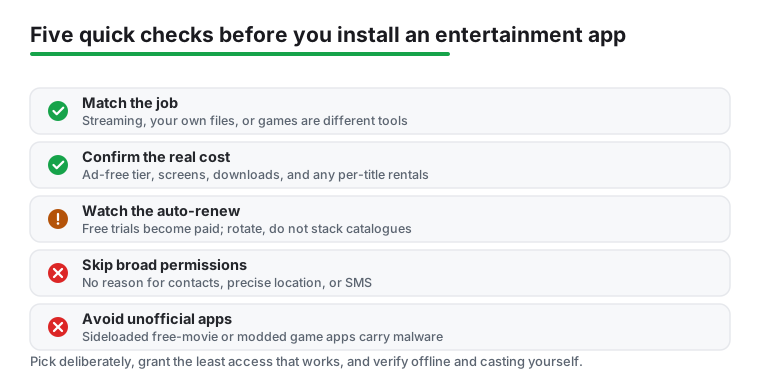
- Paying for overlapping catalogues. It is easy to stack three or four services covering the same content. Pick deliberately and rotate rather than running them all.
- Assuming one app does every job. Streaming, owning files, and gaming pull in different directions. Depth in the right tool beats one app that does everything poorly.
- Trusting unofficial or modded apps. Apps from outside official stores that promise free movies or unlocked games are a common route to malware and account theft. Android's sideloading rules also shifted in 2026, so check our sideloading changes guide before you go off the Play Store.
- Ignoring permissions. Skim what an app requests before you install, not after.
- Letting auto-renew run. Trials become paid subscriptions on apps you stopped opening. Cancel the ones you do not use.
- Filling the phone with downloads. Offline video and large game installs eat storage fast. Clear what you have finished.
How we pick
Every app here has been installed and used hands-on, judged on real viewing and play sessions across phones of different ages and over both Wi-Fi and mobile data, not on store ratings. We verify casting and offline downloads ourselves rather than trusting the store copy. We take no paid placement, and an app only stays if we would keep using it.