What this category covers
Productivity apps are the tools that help you capture, plan, and finish what matters. On Android that usually breaks down into a few familiar types: note-takers and second-brain apps for ideas and reference, calendars and planners for time, to-do and task managers for what needs doing, document and receipt scanners for paper you want to keep, and email clients that tame a busy inbox. Some apps try to do all of it; most do one job well. The right pick depends less on the longest feature list and more on the one workflow you repeat every single day.
Five jobs, rarely one app
It is tempting to look for a single app that does everything, but the five sub-types in this category are genuinely different jobs, and they rarely live well under one roof. Knowing which one you are actually shopping for saves you from installing the wrong tool and blaming yourself when it does not stick.
- Notes and second-brain apps are for capturing and keeping information you will refer back to: meeting notes, ideas, reading highlights, reference material. You want them when the core need is remembering and finding things you wrote down.
- Calendars and planners are about time and commitments that happen at a fixed point: appointments, deadlines, recurring events. Reach for these when the question is when, not whether.
- To-do and task managers handle things that need doing but are not pinned to a clock: errands, follow-ups, a shopping list. They live or die on fast capture and reminders that actually fire.
- Document and receipt scanners turn paper into clean digital files. You want one when you need a sharp, readable PDF of a contract, a receipt for an expense report, or a form to send back.
- Email clients exist to make a busy inbox manageable, with snooze, search, and a sane way to juggle several accounts.
A note app makes a poor task manager because it has no real sense of due-versus-done; a task manager makes a poor notebook because long-form text has nowhere to live. Pick the app for the job you do most, and let a second app cover the next-most-common job rather than forcing one tool to stretch.
How to choose, by sub-type
Each sub-type has its own tell for quality, and a generic feature list will not surface it. Judge each one on what it is actually for.
- Scanners: look at edge detection (does it find the page automatically and crop cleanly?), OCR accuracy (can it pull selectable, searchable text out of the scan?), and PDF output that is clean and readable rather than a giant blurry photo. Be cautious with ad-heavy free scanners for anything sensitive.
- Calendars and planners: test natural-language entry (typing "lunch with Sam Friday at 1" and getting a correct event) and, more importantly, how it handles recurring events and exceptions, which is where weak calendars fall apart.
- Task managers: the two things that matter are fast capture (a widget, a share-sheet button, voice entry) and reminder reliability. A reminder that silently fails to fire is worse than no app at all.
- Notes apps: judge linking between notes, search speed across everything you have written, and export. A notebook you cannot search is just a pile, and one you cannot export is a trap.
- Email clients: weigh snooze, search speed, and clean multi-account handling. If you check two or more inboxes, how the app unifies or separates them is the whole experience.
What to look for in general
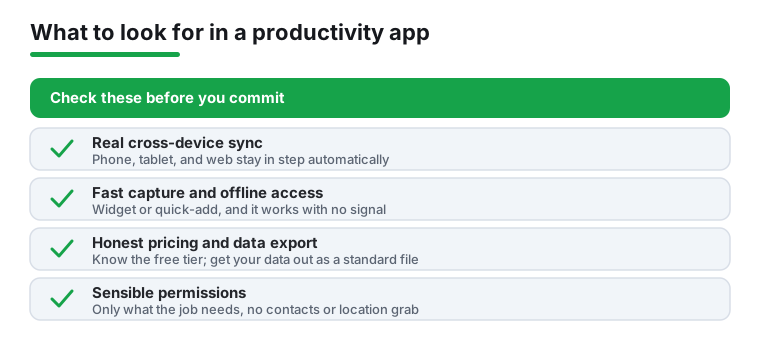
- Genuine cross-device sync. Your notes and tasks are only useful if they show up on your phone, your tablet, and the web. Check whether sync is automatic, how fast it is, and whether it works without a paid tier.
- Offline access. A planner that needs a connection is useless on a plane or a spotty commute. Look for full offline read and edit, with changes that merge cleanly when you reconnect.
- Fast capture. The whole point is friction-free input: a home-screen widget, a quick-add shortcut, voice entry, or a share-sheet button. If adding a task takes five taps, you will stop using it.
- Honest free tier and clear pricing. Many apps gate sync, reminders, or device count behind a subscription. Know what is free, what recurs, and whether a one-time purchase exists.
- Export and data ownership. Can you get your notes out as Markdown, PDF, or a standard file? Lock-in is the quiet cost of free apps; export is your exit ramp.
Privacy and your data
Productivity apps see a lot: your schedule, your contacts of who you are meeting, the documents you scan, the contents of your inbox. That makes permission hygiene and data handling worth a few minutes before you commit.
Scope the permissions to the job. A to-do app does not need your contacts, location, or call logs; a scanner needs the camera and little else. Android lets you decline anything that does not match the app's purpose, and grant it later only when a feature actually asks. For apps that want media access, use Android's selected-access option, which lets you hand over only the specific photos or files an app needs rather than your whole library. If an app refuses to work unless you grant broad access it has no business with, treat that as a reason to look elsewhere.
Know where your data goes. Some apps keep everything on the device; others sync to the maker's cloud, which is convenient but means your notes and scans live on someone else's servers. Neither is wrong, but you should know which one you are choosing. If the data is sensitive, prefer apps that are clear about cloud-versus-local storage, offer encryption, and do not bury the answer. Local-only apps trade easy sync for the assurance that nothing leaves your phone.
Be careful what you scan. Receipts are low stakes; IDs, passports, contracts, and bank statements are not. Those deserve an app with a clear, readable privacy policy and a stated stance on what happens to uploaded images, not a free scanner bankrolled by trackers and ads. If you cannot tell where a scanned document is stored or whether it is shared, do not feed it your most sensitive paperwork.
Owning your data and getting it out
The quiet cost of any free app is lock-in: the more you put in, the harder it is to leave. Export is the exit ramp, and a few standard formats keep your data portable. For notes, look for Markdown or plain text, which open anywhere and will still be readable years from now. For scans, PDF is the universal choice. For calendars, ICS (the iCalendar standard) imports and exports cleanly across Google Calendar, Outlook, Apple Calendar, and almost everything else. For tasks and events, CSV is the common lowest denominator. An app that exports to these formats respects your ownership; one that only exports to its own format, or not at all, is quietly betting you will never leave. Confirm export before you pour hundreds of notes or a year of receipts into anything.
Common mistakes to avoid
- App-hopping. Switching tools every month is itself the productivity drain. Pick something good enough and stick with it for a few weeks before judging.
- Over-configuring. Elaborate tag systems and nested folders feel productive but rarely survive a busy week. Start simple.
- Ignoring the lock-in. Free apps that hold your data hostage are expensive later. Confirm export before you invest hundreds of notes.
- Trusting ad-heavy free apps with sensitive scans. Receipts, IDs, and contracts deserve an app with a clear privacy policy, not one bankrolled by trackers.
- Chasing features you will never use. The app that helps is the one you actually open, not the one with the most settings.
How we pick
Every app in this category was installed on a real Android phone and used for everyday tasks, not judged from a spec sheet. We accept no paid placement and no sponsored rankings.