Three jobs, rarely one app
It helps to stop thinking about "photo and video apps" as one category and instead think about three separate jobs. There is capture, which is the camera and the moment you press the shutter. There is editing, which is everything you do to an image or clip afterward, from a quick crop to color grading and trimming. And there is playback and organizing, which is how you find, sort, view, and back up what you already have. These jobs pull in different directions, and the app that is excellent at one is often mediocre at the others.
That is why most people end up with two or three apps rather than one. A camera app that gives you manual controls and RAW files is not the place to build a montage with music. A gallery that is fast and tidy is not where you do careful retouching. Trying to find a single app that does all three usually means accepting a tool that is average everywhere. It is fine, and normal, to keep one app for each job and switch between them.
Capture
The stock camera on most Android phones is good enough for everyday shots, and for a lot of people it is the only camera app they need. You might reach for a third party camera when you want manual controls (shutter, ISO, focus), RAW capture for more editing headroom, or a better night or long exposure mode than your phone ships with. Be honest about whether you will actually use those. Manual controls reward practice and slow you down in the moment, so if you mostly grab quick photos of people and places, the stock camera plus a good editor will serve you better than a complex pro camera you never master.
Editing
This is where the most choice lives. Photo editors handle cropping, color, retouching, and effects on stills. Video editors trim, splice, and add music, captions, or transitions. Some apps try to do both, and a few do it well, but the workflows are different enough that many people keep them separate. The thing to watch is whether the editor keeps your original file untouched. Non-destructive editing means you can always go back and re-export, while an app that overwrites the source by default can quietly cost you the original.
Playback and organizing
A gallery app is the one you open most and think about least. Its job is to load fast, group photos sensibly, and let you find a shot from three months ago without scrolling forever. Search by date, album, and increasingly by what is in the picture all help. This is also where backup lives, and backup is where the privacy questions start, because organizing and uploading are often bundled together in the same app.
How to choose
Before you download anything, the single most useful question is what do you actually shoot and make. Someone who posts short clips to social media wants fast video trimming and captions. Someone editing family photos wants color, cropping, and a calm interface. A hobbyist who shoots RAW wants format support and fine control. Match the tool to your real habits, not to the most feature packed app in the list.
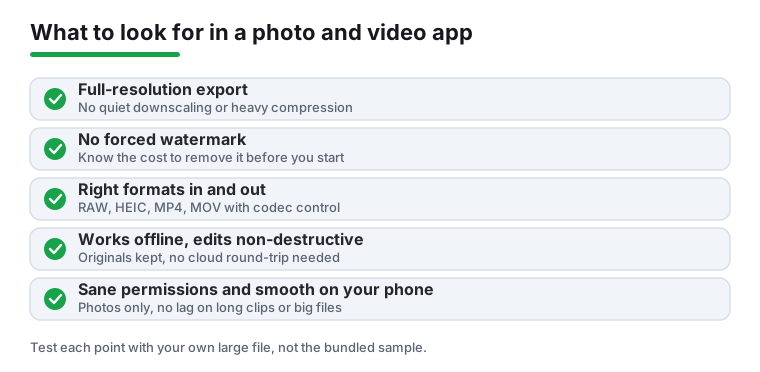
- Free versus subscription. Many capable apps are free for the basics and charge for advanced filters, effects, or removing limits. Decide whether you need those before you pay. A one time unlock is often better value than a recurring subscription if you only edit occasionally. Check what the free tier actually allows so you are not surprised mid project.
- Export quality and resolution caps. Some free apps quietly downscale output or compress it hard. Look at the export screen for a resolution and quality selector, and confirm it can match your phone's native capture size. An editor that caps video at 720p is not useful if you shot in 1080p or 4K.
- Watermarks. Plenty of editors stamp a logo on free exports, often on video or on specific templates rather than everything. That is fine for trying things out, but find out whether removing it is a one time fee or a subscription before you commit time to a project.
- Format support. For photos, check for RAW or HEIC handling if your camera produces those. For video, you want common formats in (MP4, MOV) and control over codec and frame rate out, so your clips play everywhere you send them.
- Offline operation. A real editor should do its core work with no connection. If basic edits stall without internet, your files may be processing on someone else's server, which is slower and raises a privacy question covered below.
- Performance on your phone. Timeline scrubbing, preview lag, and render times grow on older or mid range hardware. Test with a long clip or a large image rather than the bundled sample file.
The privacy angle
Photo and video apps touch some of the most personal data on your phone, so a few habits are worth keeping.
Library and storage permissions
A photo app reasonably needs access to your photos or storage, and the microphone only matters if you are recording or adding voice. It does not need your contacts or precise location to crop an image. On recent Android versions you can grant access to selected items instead of your whole library, and that is the safer default. Start narrow and widen access only if the app genuinely needs it.
Cloud upload and where photos go
Backup and "AI" features usually mean your media is being uploaded somewhere. That can be convenient and is often fine, but it is worth knowing it is happening. Check whether upload is automatic or something you trigger, whether it covers everything or only what you choose, and whether you can turn it off. An editor that needs the cloud to do simple edits is sending your files off the device to do work your phone could do locally.
EXIF location in shared photos
Photos often carry hidden metadata called EXIF, which can include the exact location and time a shot was taken. When you share a photo directly, that data can travel with it. Many messaging apps and social platforms strip it, but not all, and not always. If you are sharing publicly or with people you do not know well, look for an option to remove location data, or use an app that strips EXIF on export. This matters most for photos taken at home or anywhere you would rather not pin on a map.
Subscription traps
Some apps lean on a free trial that converts to a recurring charge, or bury core features behind a subscription that is easy to start and harder to cancel. Read what the free tier includes, note when a trial ends, and prefer a clear one time purchase when your use is light. If an app pushes hard for a subscription before you have done anything useful, that is a reason to be cautious, not a reason to hurry.
Common mistakes to avoid
- Judging an app by its filters alone, then finding the export is watermarked or quality capped after the work is done.
- Granting access to all photos when the app supports picking individual files.
- Installing five overlapping editors instead of learning one well. Depth beats variety here.
- Ignoring storage. Video projects and high resolution exports fill space fast, so check where renders land and clear old project files.
- Paying for a subscription when a one time unlock or a free tool covers what you actually do.
How we pick
Every app here was installed and used hands on across a range of real Android phones at different ages and price points. We check export quality, watermarks, offline behavior, and permissions ourselves. There is no paid placement and no bought rankings, and nothing is listed that we would not keep on our own devices.