
Best File Manager Apps for Android (2026)
A good file manager turns your phone from a cluttered junk drawer into something you can actually navigate. Over the past few months we installed and lived with dozens of them, moving files around, digging into ZIP archives, and connecting to network drives. These are the twelve we kept coming back to in 2026, whether you want something simple and clean or a power tool that does it all.
1. Files by Google
This is the one we recommend to most people, and it comes preinstalled on a lot of phones already. It is fast, clean, and the Clean tab genuinely helped us claw back several gigabytes of junk files and old screenshots. Nearby Share for sending files phone to phone works without a hitch. It will not satisfy power users, but for everyday tidying it is hard to beat.
2. Solid Explorer
Solid Explorer has been our daily driver for years, and it still feels the most polished. The dual pane view makes dragging files between folders effortless, and it connects to FTP, SMB, and every major cloud account you can name. There is a paid license after the trial, but in our testing it was money well spent for the smooth Material design and rock solid archive handling.
3. FX File Explorer
FX strikes a lovely balance between friendly and capable. We appreciated that it ships with no ads and no sketchy permissions, which is rare in this category. The built in text editor, media viewers, and network browsing all just work. Pay once to unlock the network add on and you get a quietly excellent tool that respects your privacy and your attention.
4. Total Commander
Total Commander looks like it wandered in from 2005, and honestly that is part of its charm. It is completely free, has no ads, and is fantastically powerful once you learn its layout. We used it to batch rename hundreds of photos and to access an SMB share without paying a cent. The interface is dense, but for sheer capability per kilobyte nothing else comes close.
5. MiXplorer
MiXplorer is the cult favorite among Android tinkerers, and after a week with it we understood why. It is endlessly customizable, handles dozens of archive formats, and connects to nearly any cloud or network protocol through add ons. You install it from a forum rather than the Play Store, which is a small hurdle, but the payoff is one of the most flexible managers we have ever used.
6. Cx File Explorer
Cx File Explorer is the free option we point newcomers toward when Files by Google feels too basic. The home screen neatly separates internal storage, SD card, network, and cloud, so you always know where you are. In our testing it browsed our home NAS over SMB without fuss, and the analyzer view made it easy to spot what was eating space. No nagging ads either.
7. Material Files
If you care about open source software, Material Files is a treat. It is free, ad free, and follows Google's design language so closely it feels like a system app. We loved the clean archive viewing and the FTP and SMB support baked right in. It does not try to be a Swiss Army knife, but for browsing local and network files with zero clutter it is a joy to use.
8. Amaze File Manager
Amaze is another open source pick, and it is wonderfully lightweight. The app launched instantly on an older phone we tested where heavier managers stuttered. It covers the essentials nicely with a built in app manager, a basic editor, and root browsing for those who need it. The design is simple and the footprint is tiny, which makes it perfect for budget or aging devices.
9. X-plore File Manager
X-plore brings back the classic dual pane tree view, and power users tend to fall hard for it. We used it to copy files between two cloud accounts directly, no download then reupload required, which saved real time. It reads PDFs, plays media, and even has a built in hex viewer. The look is utilitarian, but the feature list runs deep and most of it is free.
10. ASTRO File Manager
ASTRO is one of the oldest names here, and the latest version has aged gracefully. The storage breakdown chart helped us understand where our space went at a glance, and the cleaner tool flagged duplicates we had forgotten about. It is ad supported in the free tier, which we found mildly annoying, but the cloud integration and clean layout still make it a solid everyday choice.
11. Root Explorer
For rooted phones, Root Explorer remains the gold standard. It gives you full read and write access to system folders, which we needed when editing build files and swapping system fonts. The dual pane mode and built in text editor make tweaks quick. This is strictly a tool for people who know their way around root, but for that crowd it is reliable and worth the purchase price.
12. Ghost Commander
Ghost Commander is a free, open source throwback that punches above its weight. The two panel layout makes moving files feel deliberate and safe, and it connects to FTP, SMB, and cloud through plugins. We ran it on a low end tablet and it never lagged. The visuals are plain, but if you want a dependable, no cost manager with classic ergonomics, this one delivers.
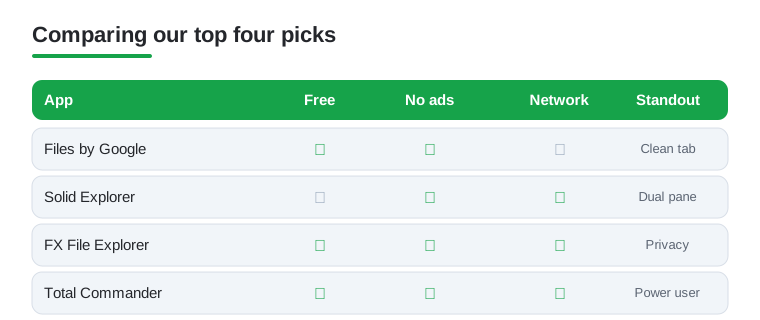
Not sure where to start? Here is how our four top picks stack up on the things people ask about most.
How to choose a file manager for Android
Most people install a file manager once and then never think about it again, which is exactly why the choice deserves a few minutes of attention up front. A file manager is not like a single purpose app you open now and then. It sits between you and everything stored on your device, so the qualities that matter are different from the ones that sell a flashy game or a photo editor. Below is the way we think about the decision, in roughly the order we weigh it.
Start with what you actually do
The honest first question is whether you need a third party app at all. Android includes a built in Files app that covers the basics: browsing folders, deleting things, moving a download into the right place, and freeing up a little space. If that is the extent of your needs, the built in tool is a perfectly reasonable answer and one less app to vet.
You start to outgrow it when your habits get more specific. Common reasons to reach for a dedicated manager include:
- Archives. Opening, creating, or extracting ZIP and similar formats without a separate utility.
- Network and cloud. Browsing an SMB share, an FTP server, or a cloud account as if the files were sitting on the phone.
- Bulk work. Batch renaming, moving hundreds of files at once, or comparing two folders side by side.
- Analysis. Seeing what is eating your storage so you can make informed cleanup decisions.
Match the tool to the task. A heavyweight, dual pane power tool is wasted on someone who only wants to clear out screenshots, and a minimalist browser will frustrate someone juggling three network drives.
Look at how it feels every day
Beyond features, the texture of daily use matters more than people expect, because a file manager is something you reach for in small, frequent moments rather than long sessions. We pay attention to how quickly the app opens, whether navigating folders feels obvious, and how it behaves when an operation goes wrong. A clear undo, a sensible confirmation before deleting, and a layout you can read at a glance all reduce the small risks that come with moving real files around. On older or budget phones, a light app that launches instantly can be worth more than a feature rich one that stutters. Try to picture the boring tasks you do most often, then judge a candidate on how little it gets in your way during those tasks rather than on its longest feature list.
Weigh cost, ads, and openness
This category has a wide spread in how apps are funded, and that funding model shapes your daily experience. Many free file managers bundle ads or cloud features, and the trade is not always worth it. A few seconds of advertising each time you open an app you use constantly adds up to real friction.
In general we lean toward two kinds of apps. The first is a reputable paid app with a one time purchase or a fair license, where the money replaces the ads and the incentive to harvest your data. The second is a well maintained open source file manager, where anyone can inspect what the code does. Neither is automatically better, but both tend to align the app's interests with yours rather than with an ad network.
Privacy and the all-files access permission
This is the part of choosing a file manager that we care about most, and it is the part most articles skip. A file manager is unusual among apps because, to do its job well, it needs broad access to your files. That is not a red flag by itself. It is simply the nature of the tool. The important thing is to understand what you are granting and to grant it deliberately.
What the permission actually does
On modern Android there is a powerful permission called All files access, known to developers as MANAGE_EXTERNAL_STORAGE. When you turn it on for an app, that app can see and change almost everything in your shared storage: your documents, downloads, photos, and the folders other apps create. It is the broadest storage permission a normal app can hold, which is why Android puts it behind a separate, deliberate toggle in settings rather than a quick in app prompt.
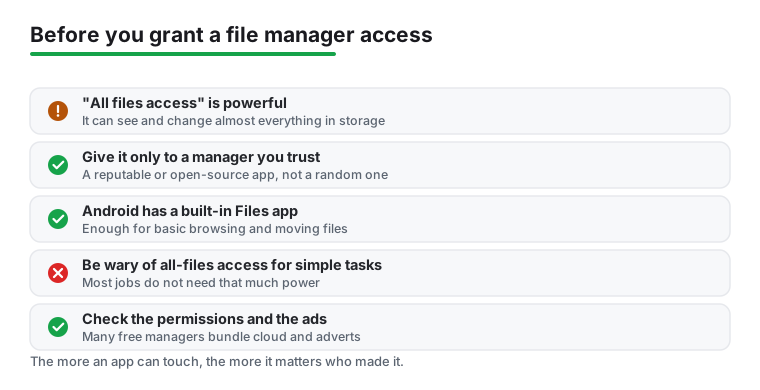
Because the reach is so wide, the rule we follow is simple: grant All files access only to a file manager you genuinely trust. A general purpose manager from a reputable developer or a well known open source project is a reasonable home for that level of access. A random app you found yesterday is not.
It helps to think about what this access could mean in practice. An app holding it can read documents you may have forgotten were on the device, look through the photos and downloads other apps left behind, and modify or delete files that are not its own. None of that is sinister in the hands of a trustworthy file manager, since that is exactly the work you installed it to do. The concern is narrower: a free app that also runs an ad business or syncs to its own cloud has more reasons to be curious about your data than a tool whose only job is moving files. The permission does not tell you the app's intentions, so the developer's reputation and funding model carry a lot of the weight.
How to evaluate an app before you grant it
A little scrutiny goes a long way. Before you hand over broad access, we suggest you:
- Check the permissions list. Look at what the app requests and ask whether each item makes sense for a file manager. Some apps ask for more than they need.
- Be wary of mismatches. Be cautious of any app that demands all-files access for simple tasks. A tool that only views images, for example, rarely needs to manage your entire storage.
- Prefer a known quantity. A reputable or open source file manager gives you something to go on, whether that is a track record or code you can inspect.
- Consider the built in option. If your needs are light, Android's own Files app avoids the question entirely.
You can review and revoke this permission at any time in your phone's settings, under the special app access section, so a grant is never permanent. If you ever feel unsure about what a given permission means, Google's own overview is a calm place to start: Android.
The practical takeaway
Choosing well in this category is mostly about matching the tool to your actual habits and then being thoughtful about access. If your needs are simple, the built in Files app may be all you require. If you want more, pick a reputable or open source manager, read its permission list before installing, and treat the All files access toggle as a decision rather than a reflex. Grant that broad reach only to an app you trust, revisit it in settings now and then, and your file manager will quietly do its job without becoming something you have to worry about.
Frequently asked questions
Do I really need a separate file manager on Android?
Many phones now ship with a built in files app, and for light use that may be enough. But once you start working with archives, connecting to network drives, or moving lots of files at once, a dedicated manager like Solid Explorer or Files by Google makes life far easier. We think most people benefit from installing one.
Are these file manager apps safe to use?
The ones we recommend here are. We deliberately favored apps with clean permission requests and no shady ad behavior, such as FX File Explorer and Material Files. Stick to well known names, check what permissions an app asks for, and avoid random managers promising to boost your phone. For broader protection, pairing one with a trusted security tool is wise.
Which file manager is best for accessing network and cloud storage?
Solid Explorer and X-plore were our favorites for this. Both connect to SMB shares, FTP servers, and cloud accounts like Google Drive and Dropbox, then let you browse them as if the files were local. X-plore even copies between two cloud accounts directly, which saved us a lot of waiting during testing.
Do any of these require rooting my phone?
No, almost all of them work perfectly on a normal, unrooted phone. Only Root Explorer truly needs root access to reach its full potential. Apps like Amaze and MiXplorer offer optional root browsing if you have it, but they run just fine without, so you can ignore that feature entirely if it does not apply to you.
What is the all-files access permission, and should I grant it?
All files access, known to developers as MANAGE_EXTERNAL_STORAGE, lets an app see and change almost everything in your shared storage. A file manager genuinely needs broad access to do its job, so the permission is not a red flag on its own. The advice is to grant it only to a file manager you trust, such as a reputable or open source app, and to be wary of any app that demands it for simple tasks. You can review or revoke it any time in your phone's settings.
Is the built in Files app enough on its own?
For a lot of people, yes. Android includes a built in Files app that handles browsing, deleting, moving, and basic cleanup, and it avoids the question of broad storage permissions entirely. You really only outgrow it when you need archives, network or cloud browsing, bulk operations, or detailed storage analysis. If none of those describe you, sticking with the built in tool is a perfectly sensible choice.