Best Compass Apps for Android (2026)
- Best overall and the one we recommend first: Compass by Snapp Mobile, free, offline, and ad light.
- Best for camera sighting: Smart Compass by Smart Tools, a polished paid pick.
- Best classic dial: Compass 360 Pro for orienteering with a paper map.
- All work offline, since they read the phone's magnetic sensor.
Your phone already has a magnetometer, so the right compass app turns it into a tool you can actually trust on the trail or in a parking garage. We tried dozens of them on hikes, road trips, and the occasional hunt for a north facing balcony, looking for ones that calibrate fast, read clearly in sunlight, and do not bury the needle under ads. Below are the compass apps we keep installed, with honest notes on what each does well. For more in this space, browse our full Navigation & Auto hub.
1. Compass by Snapp Mobile
This is the no frills compass we recommend to most people first. It shows a clean dial, your current heading in degrees, and your latitude and longitude, with nothing else getting in the way. In our testing it calibrated quickly with the usual figure eight wave and stayed steady indoors. It is free with light ads, and it works fully offline, which matters when you are out of signal range.
2. Digital Compass by Axiomatic
Axiomatic's compass is the one we hand to friends who want something that just looks right. The dial is crisp, the magnetic and true north toggle is easy to find, and it overlays your bearing on the live camera so you can sight a distant peak. It suits hikers and casual navigators alike. The app is free, supported by ads you can remove with a small one time purchase.
3. Compass 360 Pro
Compass 360 Pro is a longtime favorite that feels like a classic military style sighting compass on your screen. We like the large readable numerals and the smooth needle that does not jitter on every step. It is genuinely useful for orienteering with a paper map. The free version covers the basics, and the paid Pro tier strips ads and adds a magnetic field readout.
4. Smart Compass by Smart Tools
This one leans into the camera overlay idea and does it better than most. Point your phone at the horizon and a bearing is laid over the real world, which we found handy for noting the direction of a landmark. It also reads magnetic field strength from the same sensor. It is a paid app, part of a respected utility bundle, and it feels polished.
5. GPS Compass Navigator
GPS Compass Navigator is the pick for people who want more than a bare needle. Alongside the compass it shows GPS coordinates, altitude, speed, and a sunrise and sunset readout, so it doubles as a pocket field tool. We reached for it on a long day hike and appreciated having everything on one screen. It is free with ads, and the extra sensor data is genuinely accurate rather than decorative.
6. Compass Steel 3D
If you care how a compass looks, Compass Steel 3D is the prettiest one we tried. The brushed metal dial tilts in 3D as you move the phone, and you can theme it to taste. Underneath the looks it is a capable compass with true north correction and a GPS panel. It is free with in app purchases and stayed responsive on older Android phones.
7. PixelCompass
PixelCompass is the minimalist choice for anyone who finds most compass apps cluttered. It strips things back to a clean needle, your heading, and not much else, which makes it fast to read at a glance. We liked it as a widget on the home screen for quick direction checks around town. It is free, lightweight, and refreshingly free of the gimmicks that bog down busier compass apps.
8. Compass and GPS Tools
This is a Swiss army knife that happens to lead with a solid compass. Beyond the needle you get a spirit level, a ruler, a flashlight, and a unit converter from one tidy menu. We found it handy on a camping trip when we did not want five separate utilities. It is free with ads, and the compass calibrated reliably and held its bearing well.
9. Gyro Compass
Gyro Compass blends the magnetometer with your phone's gyroscope to smooth out the twitchy readings that plague cheaper compass apps. In practice that meant a noticeably calmer needle when we walked over reinforced concrete and near cars. It suits anyone frustrated by a bouncing bearing. The app is free with ads, and while the design is plain, the steadier accuracy is the reason we kept it on the phone.
10. Compass Galaxy
Compass Galaxy is a clean, modern take that pairs a readable dial with handy extras like a coordinate display and a quick share button for sending your location to a friend. We liked how fast it launched and how little it nagged us. It is free with modest ads, and the bright high contrast layout was easy to read on a sunny ridge where dimmer apps washed out.
11. Sailing Compass
Built with boaters in mind, Sailing Compass shows heading, course over ground, and speed in a layout that makes sense on the water. We tried it on a kayak day and the large numerals were easy to read with wet hands. It suits anyone who needs a marine bearing. For the reliability of dedicated units, see our Garmin Android GPS guide. It is free with a paid upgrade.
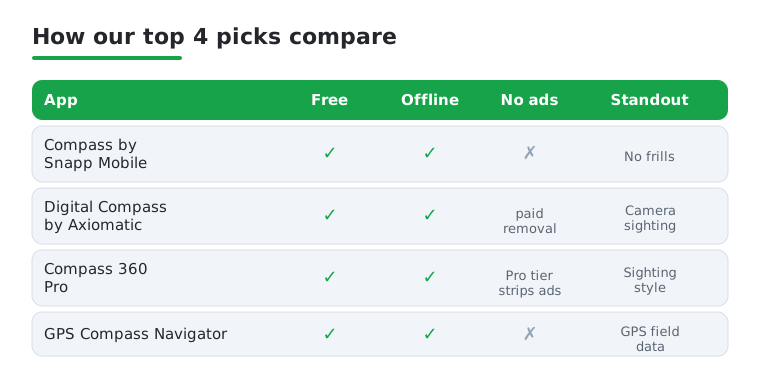
Not sure which to install first? This quick comparison lines up four of our top picks against the things that matter most on the trail: price, offline use, ads, and what makes each one stand out.
How to choose a compass app for Android
A compass app is one of those tools that looks identical from the store listing but behaves very differently once you are standing at a trail junction trying to work out which way is north. The good news is that picking a sensible one is not complicated. Once you understand what the app is actually doing under the hood, the differences between them get easy to judge, and you can ignore most of the noise on the listings page.
It all runs on one tiny sensor
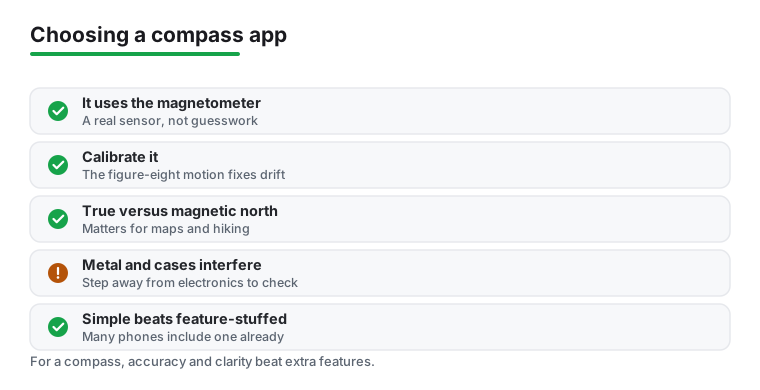
Every Android compass app reads the same piece of hardware: the magnetometer, a small sensor that measures the Earth's magnetic field and works out which way the device is pointing. The app does not invent direction on its own. It simply takes the numbers the sensor reports and draws a dial around them. That single fact explains almost everything about how these apps behave, including why two apps on the same phone can disagree, and why none of them can be more accurate than the sensor underneath.
Because the work happens on the sensor and not over the internet, the core compass function runs completely offline. You do not need a signal to find north. This is also why a compass app is worth installing before you leave home rather than when you are already out of range and cannot download anything.
Calibration is not optional
The single most important habit with any compass app is calibration, and it is the step most people skip. The magnetometer drifts over time and gets confused whenever it passes near anything magnetic, so it needs to be reset regularly. The standard fix is the figure eight motion: hold the phone in front of you and trace the shape of the number eight in the air a few times, rotating your wrist as you go. This lets the sensor sample the field from several angles and remap itself.
If your app keeps nagging you to calibrate, that is usually a sign that something nearby is interfering rather than a flaw in the app. A well behaved compass app will tell you honestly when its reading is unreliable instead of confidently pointing the wrong way. That honesty is worth more than any visual flourish, so it is one of the first things to look for.
What can throw the reading off
A magnetometer is sensitive, and plenty of ordinary things will disturb it. It helps to know the usual suspects so you can rule them out:
- Metal: car bodies, steel railings, rebar in concrete, desks, and belt buckles all bend the local magnetic field.
- Phone cases: any case with a magnetic clasp, a card holder with a magnet, or a kickstand magnet sits millimetres from the sensor and is a common cause of stubbornly wrong readings.
- Electronics: speakers, motors, chargers, and other phones produce their own fields. A magnetic car mount is a frequent offender, so if you navigate from the dashboard, a non magnetic cradle keeps things clean.
When a reading looks wrong, step a few paces away from cars and metal, take the phone out of a magnetic case if you can, run the figure eight, and check again. Nine times out of ten the problem is the environment, not the software.
True north versus magnetic north
This trips up more people than calibration does. Magnetic north is the direction the needle physically points, following the Earth's magnetic field. True north is the actual geographic North Pole, which is what printed maps and grid references are drawn around. The two are not the same place, and the angle between them, called declination, changes depending on where you are standing.
For wandering around town the difference rarely matters. For navigating with a paper map or matching a bearing to a chart, it matters a lot. A good compass app lets you toggle between magnetic and true north and corrects the declination automatically from your GPS position. If you intend to do any real map work, make sure the app you choose offers that toggle, and set it to true north before you start.
You may already have one
Before you install anything, it is worth checking what your phone already includes. Many Android phones ship with a basic compass, sometimes tucked inside the camera app, the clock, or a maps screen. For occasional use, that built in option may be all you need. There is no reason to add a separate app for a feature you already carry, so try the stock tools first and only reach for a dedicated app when you want something more readable or more capable.
Simple and accurate beats feature stuffed
It is tempting to pick the app with the longest feature list, but a compass is a case where restraint wins. The job is to show direction clearly and reliably. An app that calibrates quickly, reads well in bright sun, and keeps a steady needle is more useful than one crowded with weather panels, altimeters, and animated themes that you will never open. Clutter also slows the screen down and makes the heading harder to find at a glance, which is the one moment you actually needed it.
A quick word on the battery saver and similar add ons that some compass apps advertise: treat them as filler. The compass sensor itself draws almost nothing, and a bundled cleaner or saver is mostly placebo rather than a real benefit. Judge a compass app on the compass, not on the extras stapled to it.
Match the app to how you will use it
The right choice really comes down to your situation:
- Casual orientation around town: if you just want to know which way you are facing when you leave a metro station or orient yourself in a new neighbourhood, pick the simplest, fastest, clearest app you can find. A minimalist dial or a home screen widget is perfect, and you do not need GPS extras at all.
- Hiking and the outdoors: here you want a true north toggle with declination correction, a steady needle that does not jitter as you walk, and good readability in sunlight. GPS coordinates, altitude, and a camera sighting view are genuinely useful for matching the landscape to a map. Prioritise something that works confidently offline.
- On the water or in a vehicle: a layout built for the task, showing heading and course over ground in large numerals, beats a generic dial. Keep magnetic clutter, especially car mounts, well away from the phone.
Whichever way you lean, the test is the same. Install one, calibrate it with the figure eight, walk it past a few landmarks you can verify, and keep the one whose needle you trust. Accuracy and a clear reading are the whole point, and everything else is decoration.
Frequently asked questions
Are Android compass apps actually accurate?
They can be, as long as your phone has a magnetometer and you calibrate it. Most phones from the last several years include the sensor, and a quick figure eight wave of the device resets the reading. In our testing the better apps landed within a few degrees of a real handheld compass. Stay away from cars, speakers, and metal railings while you check, since they throw the needle off more than any app flaw.
Why does my compass app keep asking me to calibrate?
Calibration drifts whenever the phone passes near magnetic interference, so anything from a magnetic case to a steel desk can trigger the prompt. The fix is the same figure eight motion, tracing the shape a few times in the air to let the sensor remap. If it never settles, your case or a nearby magnet is usually the culprit. Removing a magnetic phone mount fixed it instantly for us more than once, so if you navigate from the dash, a non magnetic cradle alongside a good car launcher app keeps readings clean.
What is the difference between true north and magnetic north?
Magnetic north is where the compass needle points, and it shifts based on the planet's magnetic field. True north is the actual geographic North Pole that maps are drawn around. The gap between them is called declination, and it varies by location. Good compass apps let you toggle to true north and correct for declination automatically using your GPS position, which is the setting you want when reading a real map.
Do compass apps work without an internet connection?
The compass itself works completely offline, since it reads the phone's built in magnetic sensor rather than the network. That makes a compass app a smart thing to install before you head somewhere remote. Features that lean on GPS coordinates or maps may want a signal, though GPS positioning works offline too once satellites are acquired. We always pair one with a good offline map and, on road trips, a tidy GPS navigation app for the drive home.
Do I need a compass app if my phone already has one?
Often you do not. Many Android phones include a basic compass somewhere in the camera, clock, or maps screen, and for occasional use that is enough. Reach for a separate app only when you want something more readable, a true north toggle with declination correction, or extras like GPS coordinates and a camera sighting view for hiking. Try the built in option first, then decide whether you actually need more.
Are the battery saver or cleaner features in some compass apps worth using?
Not really. The compass sensor draws almost no power on its own, so a bundled battery saver or cleaner is mostly placebo rather than a meaningful benefit. These add ons tend to be filler that crowds the screen. Judge a compass app on how quickly it calibrates, how steady the needle is, and how clearly it reads in sunlight, and ignore the extras stapled on around it.